💚 Cerebral Palsy From the Inside
An October Series by Our Beautiful Challenges
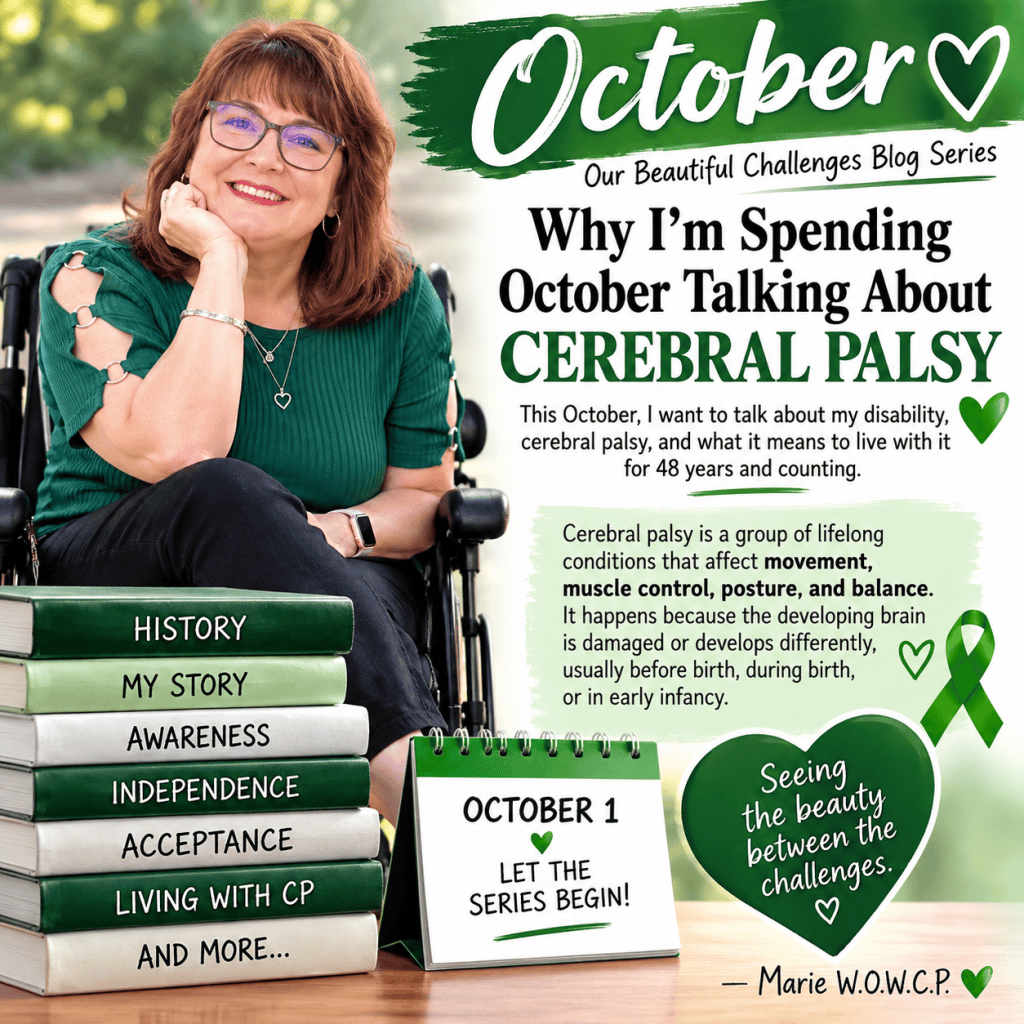
This October, I want to spend some time talking about something that has been part of my life since the day I was born: cerebral palsy.
Cerebral palsy is a group of lifelong conditions that affect movement, muscle control, posture, and balance. It results from abnormal development of the brain or damage to the developing brain, usually before, during, or shortly after birth.
But that is the medical definition.
I want to talk about what cerebral palsy means when you’re actually the person living with it.
My cerebral palsy began at birth. My family has always understood that what happened involved mistakes in my medical care around the time I was born. My parents were very young at the time, and they did not pursue legal action.
What happened that day would affect the rest of my life.
But it would also become a learning experience—not only for me, but for my parents, my brothers, my extended family, my teachers, and just about everyone who became part of my life.
Growing up with cerebral palsy meant we were all learning together.
My parents had to learn how to raise a daughter whose life wasn’t going to follow the path they might have expected. I had to learn how to live in a body that moved differently. My family had to learn when I needed help and when I needed the opportunity to figure something out for myself.
And as I got older, I had to learn something even bigger:
Having cerebral palsy wasn’t only about learning how to move my body. I had to learn how to live my life with it.
That has taken me 48 years—and I’m still learning.
I’ve learned how to advocate for myself.
I’ve learned that independence doesn’t mean doing everything without help.
I’ve learned to listen to my body.
I’ve learned that my body can adapt.
I’ve learned that cerebral palsy can change the way I have to approach something without taking away my ability to experience it.
And perhaps most importantly, I’ve learned that cerebral palsy is part of my story, but it isn’t the only thing that defines me.
That’s why I want to dedicate October to talking about CP.
October 6 is World Cerebral Palsy Day, but I don’t think one day is enough for me to tell this story.
Throughout this month, I want to look at where our understanding of cerebral palsy began, including the story of Dr. William John Little and what was once called Little’s disease. I want to talk about my own spastic diplegia, what CP looked like during my childhood, what it means to be an adult aging with cerebral palsy, and how my relationship with my body has changed over the years.
Some of these posts will be educational.
Some will be personal.
Some might be difficult.
And some will celebrate just how much this body of mine has accomplished.
Because after 48 years with cerebral palsy, I don’t want to tell you only what a medical textbook says about my disability.
I want to tell you what cerebral palsy looks like from the inside.
Welcome to my October cerebral palsy series.
💚 Seeing the beauty between the challenges.
— Marie W.O.W.C.P.


Leave a comment