Aging With Cerebral Palsy: My Body Is Changing, and So Am I
For most of my life, I have heard something about cerebral palsy:
“Cerebral palsy doesn’t get worse.”
Technically, that’s true.
Cerebral palsy is considered a non-progressive neurological condition. The original injury or difference in the developing brain that caused my cerebral palsy isn’t continuing to progress.
But after living with cerebral palsy for 48 years, I’ve learned that there is another part of the story.
Cerebral palsy may be non-progressive, but the body living with cerebral palsy still ages.
And I don’t think we talk about that enough.
My Cerebral Palsy Didn’t Change, But My Body Did
When I was younger, I didn’t think very much about what cerebral palsy would look like when I got older.
I was busy living.
I was trying to go to school, work, have relationships, be independent, and experience life.
But my body was working hard through all of those years.
Walking differently takes energy.
Keeping my balance takes energy.
Working with tight muscles takes energy.
Even ordinary daily activities can require much more effort when you have cerebral palsy.
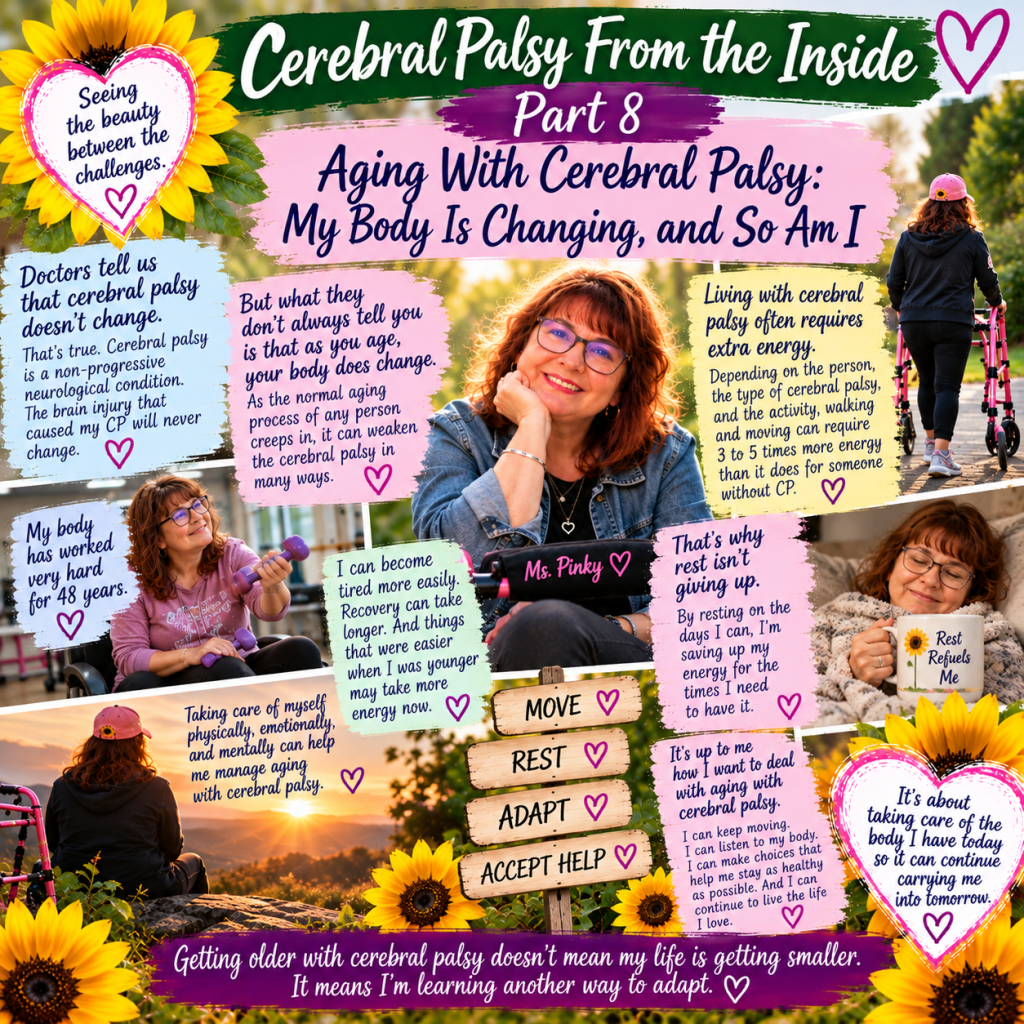
Depending on the person, the type of cerebral palsy, and the activity, walking and moving can require considerably more energy than it does for someone without CP. You may sometimes hear people with cerebral palsy describe it as using three to five times more energy.
Whether or not that exact number describes every person or every activity, I know what the extra effort feels like in my own body.
Think about what that means over a lifetime.
My body has spent 48 years using extra energy to do things other people may be able to do without thinking twice.
That’s a lot of work for one body.
And then the normal aging process begins too.
That’s when things can start to feel different.
Nobody Really Prepared Me for This Part
Doctors told us that cerebral palsy itself wouldn’t progress.
What I didn’t always understand was that aging could change how my body experiences cerebral palsy.
I can become tired more easily.
My muscles and joints have years of wear on them.
Things that were easier when I was younger may take more energy now.
Recovery can take longer.
And sometimes I have to think more carefully about where I want to spend my energy.
That doesn’t mean my cerebral palsy suddenly became progressive.
It means I’m getting older in a body that has already worked very hard for 48 years.
That’s an important difference.
So What Can I Do About It?
I can’t stop myself from aging.
None of us can.
And I can’t make my cerebral palsy disappear.
But I can make choices about how I take care of the body I have.
For me, that means trying to take care of myself physically, emotionally, and mentally.
And believe me, that is easier said than done.
Physical health might mean exercising and moving my body in ways that work for me.
It might mean stretching.
It might mean listening when my body needs rest.
It might mean asking for help.
Emotional and mental health matter too.
I can’t spend every day fighting with my body because it isn’t doing what I want it to do.
I’m learning that taking care of myself also means accepting that some days will look different from others.
Rest Isn’t Giving Up
This has probably been one of the hardest lessons for me.
For years, slowing down scared me.
Part of me believed that if I slowed down, I would fall behind.
If I rested too much, maybe I would lose something.
If I stopped pushing, maybe cerebral palsy was winning.
I don’t look at it that way anymore.
When my body has to use extra energy just to move through everyday life, rest isn’t laziness. My body has earned that rest.
By resting on the days I can, I’m saving my energy for the times when I really need it.
Rest isn’t necessarily taking something away from my independence.
Sometimes rest is what helps me protect it.
I Still Get to Decide How I Live
Aging with cerebral palsy isn’t something I can completely control.
But I do have choices in how I respond to it.
I can ignore what my body is telling me and constantly fight against it.
Or I can learn from it.
I can keep moving.
I can exercise.
I can take care of my mental and emotional health.
I can rest.
I can adapt.
I can accept help.
And I can continue challenging myself without believing that I have to prove something every single day.
At 48, I’m beginning to understand that taking care of myself isn’t about trying to keep the body I had at 20.
It’s about taking care of the body I have today so it can continue carrying me into tomorrow.
Cerebral palsy has been with me since birth.
Aging is now becoming another part of that journey.
I don’t know exactly what my body will look like at 50, 60, or beyond.
But I do know how I want to approach it.
I want to work with my body, take care of it, listen to it, and give it the best opportunity I can to keep living the life I love.
Because getting older with cerebral palsy doesn’t mean my life is getting smaller.
It means I’m learning another way to adapt.
💚 Seeing the beauty between the challenges.
— Marie W.O.W.C.P.


Leave a Reply