Health & Wellness,Women’s Health & Aging
Our Beautiful Challenges
By Marie W.O.W.C.P.
There is something I have been thinking about a lot lately as I move closer to menopause.
Everywhere you look, people talk about what women should eat during this stage of life.
More protein.
More calcium.
More vegetables.
More fresh foods.
Less sugar.
Less processed food.
And while I understand why those things matter…
I also think there is a conversation missing for women like me who live with physical disabilities like cerebral palsy.
Because sometimes eating “healthy” is not as simple as people make it sound.
Sometimes people forget that physical disabilities can affect everyday things that most people never have to think about.
Things like:
- cooking
- standing for long periods
- chewing
- swallowing
- using your hands
- carrying groceries
- meal preparation
- fatigue
- and even the energy it takes just to eat
For some people with cerebral palsy, the body already works overtime every single day.
And now menopause adds another layer to that exhaustion.
That can feel overwhelming sometimes.
I think one of the hardest parts is that health advice often sounds very all-or-nothing.
As if every meal needs to be perfectly balanced.
As if every woman has the same energy level.
As if everybody works the same way.
But disabilities change things.
And honestly…
That does not get talked about enough.
There are days when simply making a meal can take more physical energy than people realize.
Days when softer foods are easier.
Days when fatigue affects appetite.
Days when convenience foods are what help maintain independence.
And I think women with disabilities deserve compassion for that—
not guilt.
Because health should not only be measured by perfection.
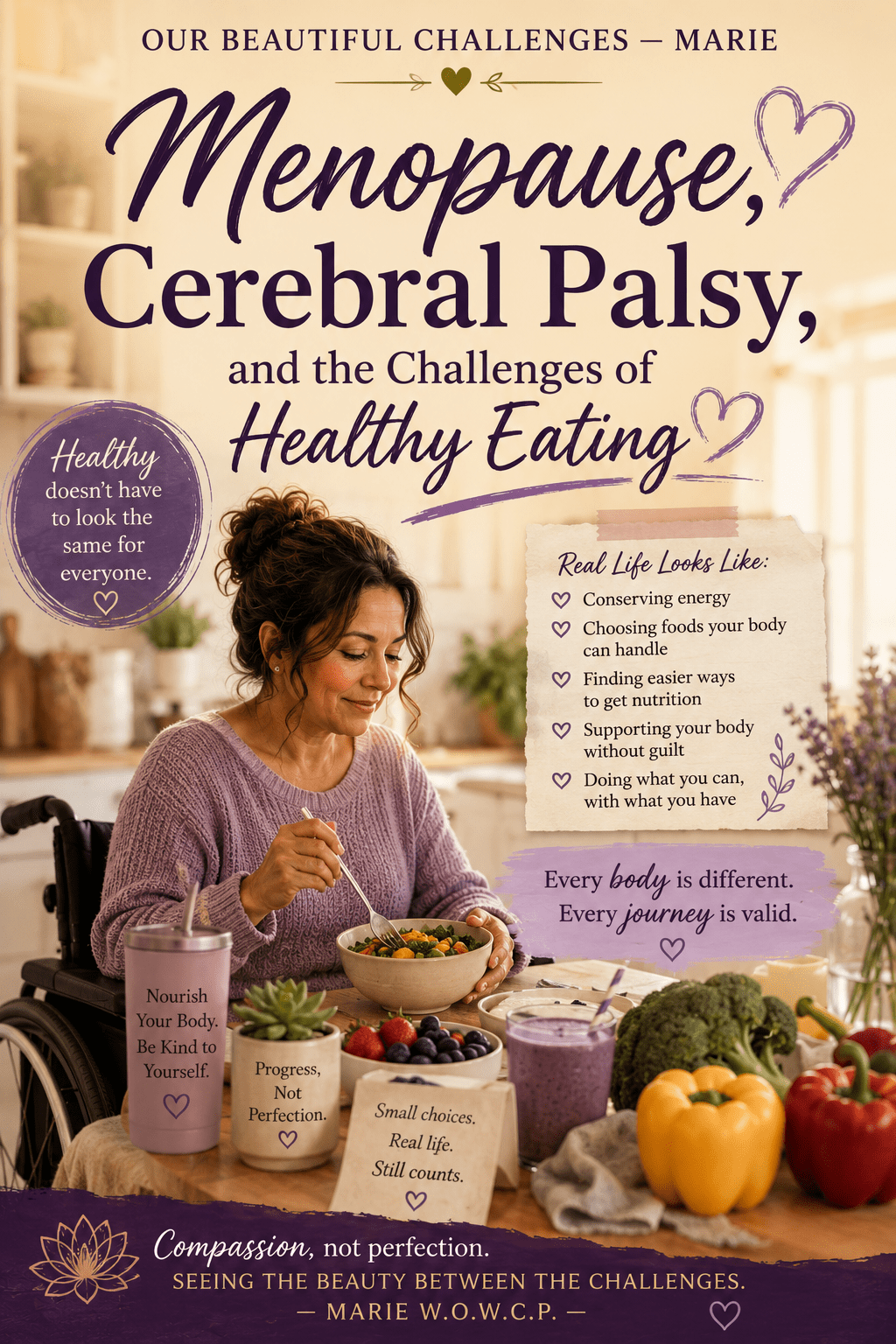
Sometimes health looks like:
- conserving energy
- choosing foods your body can handle
- finding easier ways to get nutrition
- and learning how to support your body without punishing yourself
Maybe healthy eating for someone with CP looks different from what it does for someone else.
Maybe it means:
- protein shakes
- yogurt
- frozen vegetables
- smoothies
- simple meals
- pre-cut foods
- or small meals throughout the day
And honestly?
That still counts.
I think menopause is teaching me something important:
Taking care of yourself is not about doing everything perfectly.
It is about listening to your body with honesty and kindness.
Especially when your body has already spent a lifetime working harder than most people realize.
Women with disabilities deserve conversations about menopause, too.
Real conversations.
Honest conversations.
Compassionate conversations.
Not just advice that assumes everybody moves through life the same way.
Because we don’t.
And there is nothing wrong with that. 🌻
— Marie W.O.W.C.P.
Seeing the beauty between the challenges ✌️😊💛


Leave a Reply