
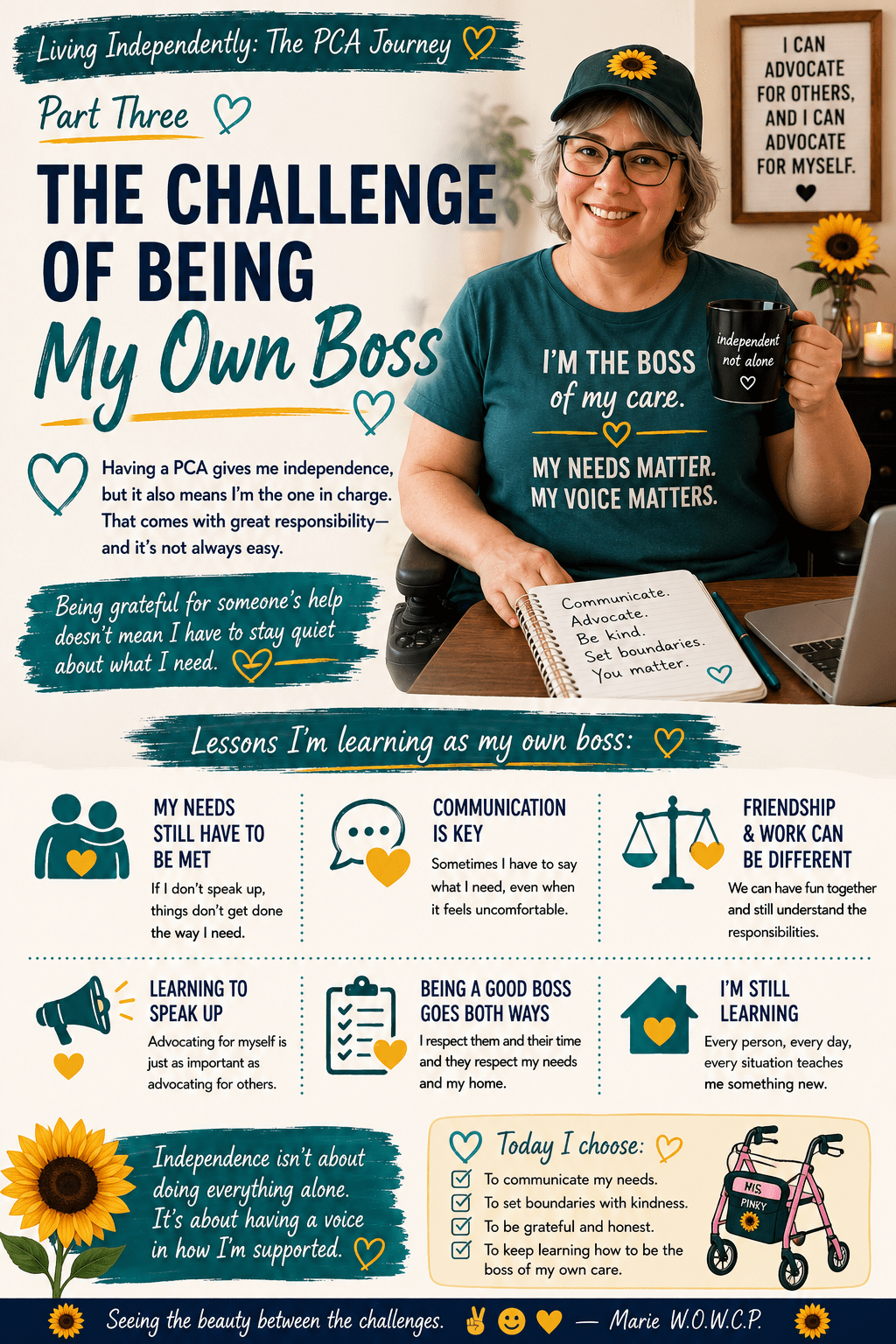
Living Independently: The PCA Journey — Part Three
Our Beautiful Challenges — Marie W.O.W.C.P.
Being part of a PCA Waiver program has given me something incredibly important: choice.
I have the ability to choose the people who help me and have a say in how that help is provided.
That freedom is a huge part of my independence.
But there’s another side of being in a self-directed PCA program that people may not always think about.
I have to be the boss.
And being the boss isn’t always easy for me.
When the Person Helping You Is Someone You Know
One of the things I appreciate about my PCA program is that I can choose people I know and trust to help me.
That makes personal care much more comfortable.
But it can also make being the boss complicated.
When someone is going out of their way to help me, I sometimes worry about asking too much.
I don’t want to sound demanding.
I don’t want someone to think I don’t appreciate what they’re doing.
And sometimes it can feel easier to say, “That’s okay,” instead of saying what I actually need.
But I’ve had to learn that being grateful for someone’s help and communicating my needs are not opposites.
I can appreciate someone and still advocate for myself.
My Needs Still Have to Be Met
This has probably been one of the biggest lessons I’ve had to learn as my own boss.
A PCA isn’t simply someone visiting my apartment.
They’re there because I need assistance with certain things.
If I don’t communicate what I need, the arrangement doesn’t work the way it’s supposed to.
That doesn’t mean I should be disrespectful or demanding.
It means I have to communicate.
Sometimes that means saying:
“I need help with this.”
Sometimes it means explaining that I need something done differently.
Sometimes it means setting a boundary.
And sometimes it means having a conversation that might feel uncomfortable.
Those conversations are part of advocating for myself.
Friendship and PCA Responsibilities Can Be Different
When you hire someone you already know, the line between friendship and work can sometimes become blurry.
There can be moments when we’re laughing, talking, or simply enjoying each other’s company.
I actually think that’s one of the beautiful parts of having someone you trust as a PCA.
But there also has to be an understanding that when they’re working as my PCA, there are responsibilities that need to be completed.
That’s where communication becomes so important.
I don’t want my relationship with my PCAs to feel cold or clinical.
I want us to be comfortable together.
I want us to laugh.
I want the people helping me to feel like they’re part of my team.
But being a team also means everyone understands their role.
Learning to Speak Up
For someone who has spent much of her life advocating for disability rights, you might think speaking up for myself would always come naturally.
It doesn’t.
Sometimes advocating for an entire community feels easier than saying to someone standing in my apartment:
“This is what I need from you today.”
I’m still learning.
I’m learning that communicating my needs doesn’t make me difficult.
I’m learning that setting expectations doesn’t mean I’m ungrateful.
I’m learning that asking someone to do the job they agreed to do isn’t the same as bossing someone around.
Most importantly, I’m learning that my needs matter.
Being a Good Boss Goes Both Ways
I also believe being the boss comes with responsibility.
I need to respect the people who work with me.
I need to communicate clearly.
I need to remember that they’re people with their own lives, feelings, and responsibilities.
I want my PCAs to feel appreciated.
But respect needs to go both ways.
A good PCA relationship shouldn’t be about one person having all the power.
For me, it works best when it feels like a partnership.
They bring their support.
I bring my knowledge of what I need.
And together, we figure out what works.
I’m Still Learning How to Be the Boss
I don’t think I’ll ever say I’ve completely figured this out.
Every person is different.
Every PCA relationship is different.
And every situation teaches me something new.
But I’ve come a long way.
Being my own boss has taught me about communication, boundaries, trust, respect, and self-advocacy.
Most importantly, it has taught me something about independence that I didn’t understand when I first moved into my apartment.
Independence isn’t only about being able to take care of yourself.
Sometimes independence means being able to say:
“This is my life. This is what I need. And I deserve to have a voice in how I’m supported.”
Being grateful for someone’s help doesn’t mean I have to stay quiet about what I need.
I’m the person living this life.
And learning to be the boss of my own care is another way I’m learning to be the author of it.
✌️ 😊 💛
Seeing the beauty between the challenges.
— Marie W.O.W.C.P.


Leave a Reply