
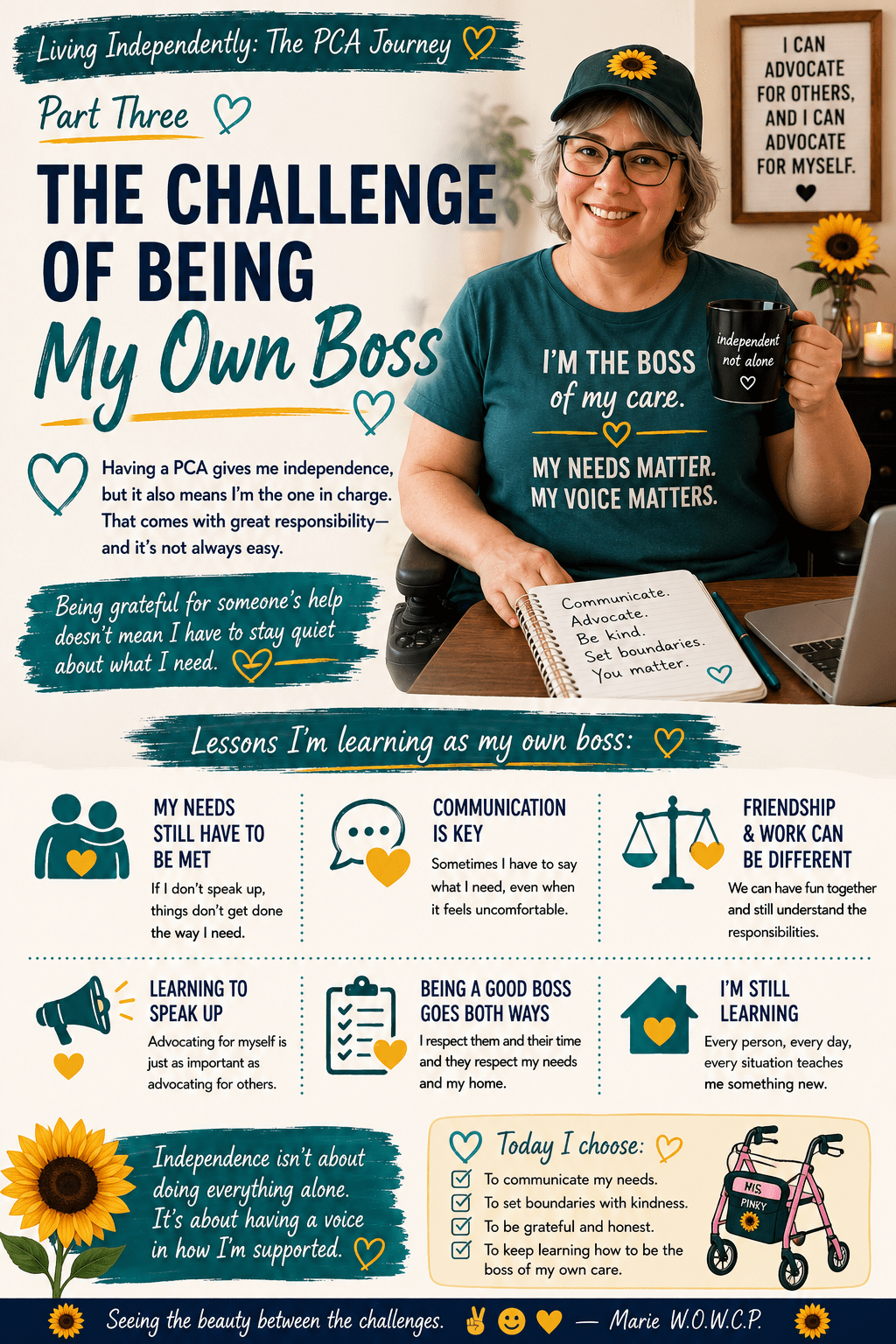
Living Independently: The PCA Journey — Part Five
Our Beautiful Challenges — Marie W.O.W.C.P.
Trusting a PCA can almost be like trusting a partner.
That might sound like an unusual comparison, but when you think about how involved a PCA can become in your everyday life, it makes sense.
Depending on what kind of assistance you need, a PCA may be in your home, help prepare your meals, take you places, assist you at work, help you get dressed, or even help with something as personal as showering.
A PCA can become involved in just about every part of your life.
That’s why, for me, trust is one of the most important parts of the PCA relationship.
Trust Takes Time — Or Sometimes You Just Click
Every PCA relationship starts differently.
Sometimes you meet someone and you just click right away.
You feel comfortable talking to them. They understand your personality. Communication seems natural, and you start developing trust quickly.
Other times, trust takes longer.
Neither way is wrong.
Trust doesn’t automatically happen just because someone has been hired to be your PCA.
They have to get to know me, and I have to get to know them.
They need to learn my routines, my preferences, my boundaries, and how I like to be assisted.
At the same time, I’m learning about them.
I’m figuring out how comfortable I am with them and whether I can depend on them.
Trust is something we build together.
My Three-Month Grace Period
One thing I’ve learned from my own experience is that I like to give a new PCA about a three-month grace period.
I don’t expect someone to understand everything about me immediately.
Those first few months give us time to learn about each other.
They’re learning what I need.
I’m learning how they work.
We’re figuring out how we communicate.
We’re also finding out whether we’re a good match.
After about three months, I usually have a better idea of whether the relationship is working.
If I still don’t feel comfortable or I’m consistently not getting what I need, then I may have to ask myself whether this person is the right PCA for me.
That doesn’t necessarily mean they’re a bad PCA.
Sometimes two people just aren’t a good match.
And when someone is going to be involved in personal parts of your everyday life, being a good match matters.
Every PCA May Have a Different Role
Something people may not realize is that not every PCA does the same things.
You might have one PCA who mainly helps with housework.
Another might help you get out into the community or take you places.
If you work, you may have someone who goes to work with you and assists you with your needs while you’re there.
Another PCA might help with meal preparation.
And another might assist with more intimate personal care, such as dressing or showering.
Those are very different responsibilities.
Because of that, each PCA relationship can have a different level of trust.
The amount of trust I need with someone helping me clean my apartment may be different from the trust I need with someone helping me shower.
That’s normal.
I Set My Comfort Level
This is one of the most important things I’ve learned:
I get to set the level of comfort and intimacy I want with each PCA.
Needing someone’s assistance doesn’t mean that person automatically gets access to every part of my life.
I decide what I’m comfortable with.
I decide what kind of assistance I want from that person.
I decide what parts of my life I want to share.
And I decide where the boundaries are.
A PCA may be there to assist me, but I’m still in charge of my body, my home, my privacy, and my life.
Boundaries Are a Must
Setting boundaries with a PCA is extremely important.
But those boundaries may look different with every person.
One PCA relationship might become very close and personal.
Another might stay more professional.
One PCA may know a lot about what’s happening in my life.
Another might come in, help me accomplish what I need to accomplish, and go home.
Neither relationship is necessarily better.
They’re simply different.
And I’m allowed to decide what works for me.
Boundaries can also change as trust develops.
Maybe there’s something I’m not comfortable with during the first few weeks.
After several months of working together and building trust, I might feel differently.
But that decision should always belong to me.
Trust Doesn’t Come With the Job Title
Having the title PCA doesn’t automatically mean someone has my trust.
Trust has to be earned.
That requires communication.
It requires respect.
It requires consistency.
It requires listening.
And sometimes it simply requires time.
When you’re allowing someone into very personal parts of your life, you should be able to feel safe saying:
“I’m comfortable with this.”
Or:
“I’m not comfortable with this.”
Both are equally important.
It’s Still My Life
Having a PCA has taught me that accepting assistance doesn’t mean giving up my privacy or my boundaries.
I can need help and still decide how that help is provided.
I can develop a close relationship with a PCA without giving up control.
And if a PCA relationship isn’t working, I can acknowledge that too.
Finding the right PCA isn’t just about finding someone who can complete certain tasks.
It’s about finding someone who understands that they’re entering my life.
And for that relationship to work, there needs to be trust.
I decide my comfort level.
I decide my boundaries.
I decide how much of my life I want to share.
Because no matter how involved a PCA becomes in my daily routine, one thing never changes:
It’s still my life.
✌️ 😊 💛
Seeing the beauty between the challenges.
— Marie W.O.W.C.P.


Leave a Reply