
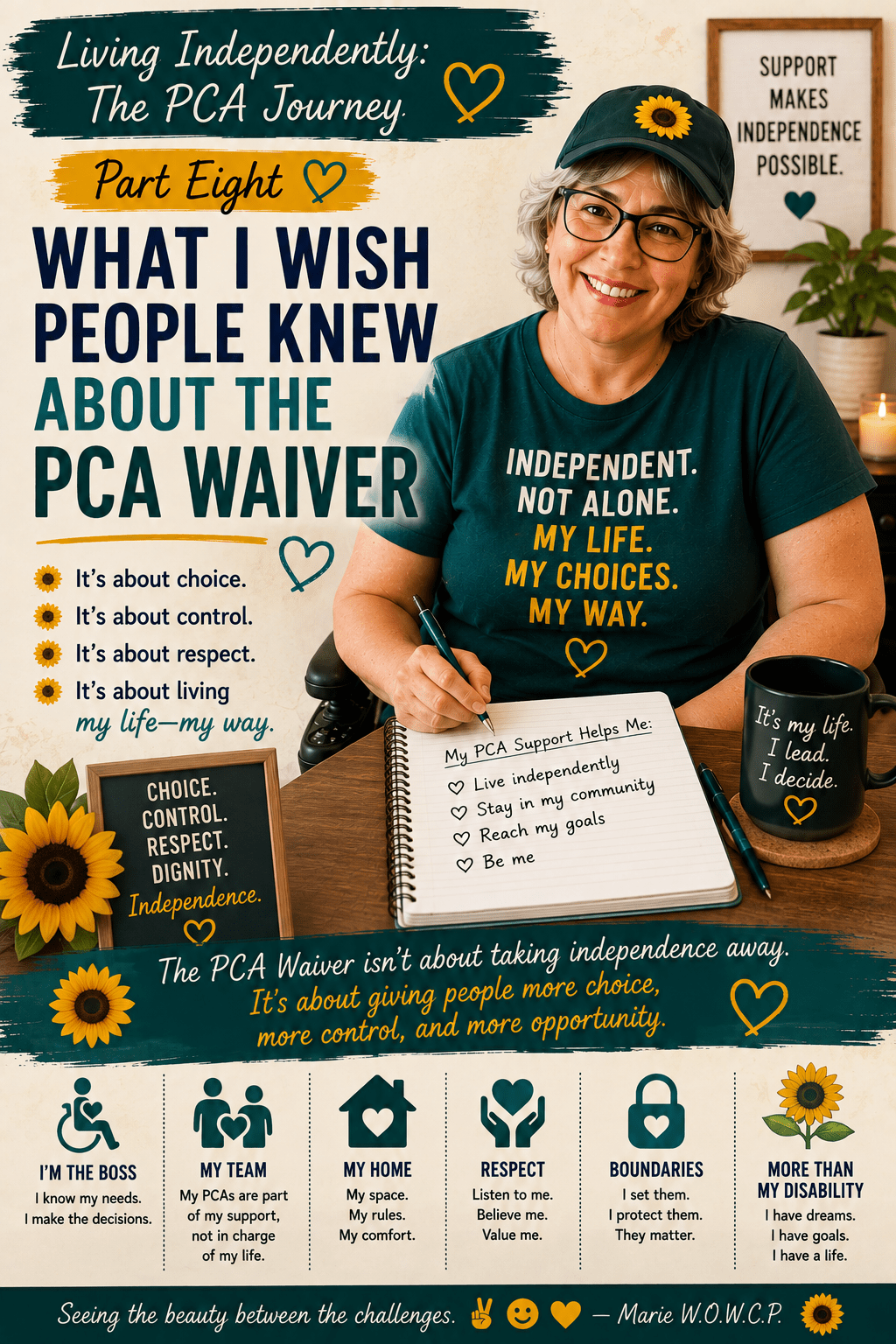
Living Independently: The PCA Journey — Part Eight
Our Beautiful Challenges — Marie W.O.W.C.P.
Throughout this series, I’ve talked about what having a PCA means to me, learning to be my own boss, choosing the right people, building trust, setting boundaries, asking for help, and redefining independence.
But there’s one more thing I want to talk about.
The PCA Waiver itself.
When people hear that someone has a PCA, they may picture a caregiver coming into a person’s home and taking care of them.
That’s not how I see my life at all.
For me, being part of a PCA Waiver program isn’t about someone taking care of my life.
It’s about having support so I can take charge of my own life.
Choice Matters
One of the things I value most about my PCA program is having a say in who helps me.
Think about how personal PCA assistance can become.
Someone may be coming into your home.
They may be helping you prepare meals.
They may be assisting with personal care.
They may be helping you get ready for the day.
They may be accompanying you into the community.
That’s why choice matters.
I don’t want to feel like a stranger has simply been assigned to my life.
I want to know the person helping me.
I want to build trust.
I want to feel comfortable.
And I want to have a voice in deciding who becomes part of my team.
I’m Not Giving Up Control
Having a PCA doesn’t mean handing control of my life over to someone else.
Actually, my experience has taught me the opposite.
I’m the one who knows what I need.
I’m the one who knows my body.
I’m the one who knows my routines.
And I’m the one who knows how I want to live.
A good PCA relationship respects that.
The PCA provides assistance.
I provide the direction.
That distinction is important.
Being the Boss Is Work
Throughout this series, I’ve also tried to be open about the fact that self-directed care isn’t always easy.
Having control also means having responsibility.
I have to communicate.
I have to set boundaries.
I have to explain what I need.
I have to figure out whether someone is the right match.
And sometimes I have to have uncomfortable conversations.
Being able to choose your own support doesn’t mean everything magically works perfectly.
You’re dealing with people.
Relationships can be complicated.
But I’d rather work through those challenges while still having a voice in my care than feel like decisions are constantly being made for me.
A PCA Isn’t a Babysitter
This is something I especially wish people understood.
Adults with disabilities who use PCAs are still adults.
We’re not being babysat.
We’re living our lives.
I may need physical assistance with something, but that doesn’t mean I need another adult deciding what I should do.
My PCA isn’t there to parent me.
They’re there to assist me.
There’s a big difference.
Support Makes Independence Possible
Sometimes society has a very narrow picture of independence.
We celebrate someone doing everything without help.
But I’ve learned that independence can look very different.
My PCA support allows me to use my energy where it matters.
It can help me maintain my home.
It can help me participate in my community.
It can help me take care of myself.
It can give me the support I need to keep building the life I want.
That isn’t dependence.
That’s supported independence.
The Person Should Always Come First
If there’s one thing I hope people take away from this entire series, it’s this:
The person receiving PCA services should remain at the center of their own life.
Listen to us.
Ask us what we need.
Respect our boundaries.
Don’t assume you know what’s best simply because we have a disability.
And don’t mistake needing assistance for being incapable of making our own decisions.
I have cerebral palsy.
I use a walker.
I have PCAs.
And I’m independent.
Those things can all exist together.
My Team Helps Me Live My Life
When I first dreamed about independence, I thought success would mean proving I could do everything myself.
Life taught me something much better.
I don’t have to prove that.
I need to know what I’m capable of doing, understand where I need support, and surround myself with people who respect both.
My PCAs are part of that support system.
They don’t live my life for me.
They help make it possible for me to live my life my way.
That’s what I wish more people understood about the PCA Waiver.
It’s not about taking independence away.
When it’s working the way it should, it’s about giving people with disabilities more choice, more control, and more opportunity to build the lives they want.
And for me, that’s what independence has always been about.
✌️ 😊 💛
Seeing the beauty between the challenges.
— Marie W.O.W.C.P.
 OUR BEAUTIFUL CHALLENGES
Leave a comment