
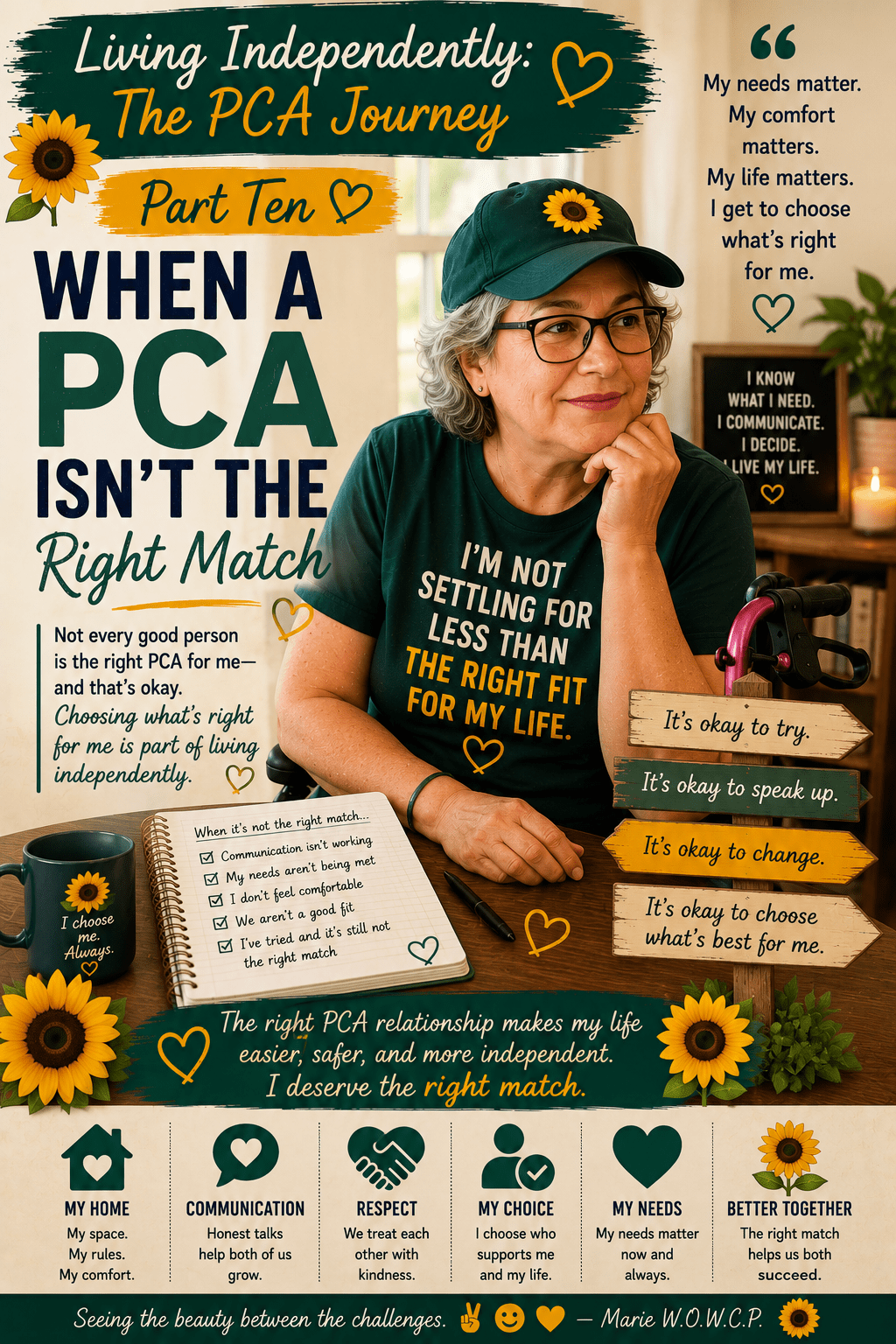
Living Independently: The PCA Journey — Part Ten
Our Beautiful Challenges — Marie W.O.W.C.P.
One of the hardest things about managing your own PCA care is realizing that not everyone is going to be the right match.
Someone can be a good person.
They can have good intentions.
They can genuinely want to help.
And they can still not be the right PCA for you.
That is something I’ve had to learn.
When someone is coming into your home and becoming involved in your everyday life, being a good match matters.
It Takes Time to Know
In my last few PCA blogs, I’ve talked about trust and the three-month grace period I like to give a new PCA.
I think time is important.
Nobody is going to know exactly how I like everything done on the first day.
They need time to learn me.
I need time to learn them.
We need time to figure out communication, routines, personalities, boundaries, and expectations.
There are going to be mistakes.
There are going to be misunderstandings.
That’s normal.
But eventually, you start to recognize whether the relationship is growing—or whether you’re constantly trying to make something work that simply isn’t working.
A Bad Match Doesn’t Always Mean a Bad PCA
This is probably the most important thing I’ve learned.
Someone doesn’t have to be a bad person to be the wrong PCA for me.
Maybe our personalities don’t work well together.
Maybe our communication styles are too different.
Maybe I need someone who takes more initiative.
Maybe I need someone who listens differently.
Maybe the tasks I need aren’t the tasks they’re most comfortable doing.
Or maybe I simply don’t feel completely comfortable around them.
That doesn’t necessarily make either one of us wrong.
Sometimes people just don’t match.
Comfort Matters
When you’re receiving PCA services, comfort is important.
This person may be in your home.
They may see you when you’re tired.
They may help you when you’re frustrated.
Depending on their role, they may assist you with very personal care.
I shouldn’t have to feel uncomfortable in my own home because I’m afraid to tell my PCA what I need.
I shouldn’t feel like I have to constantly apologize for needing assistance.
And I shouldn’t be afraid to set boundaries.
My home should still feel like my home.
Am I Getting What I Need?
There’s another question I think is important:
Am I actually getting the assistance I need?
Having someone physically present doesn’t automatically mean I’m being properly supported.
Maybe certain things aren’t getting done.
Maybe I keep having to remind someone about the same responsibility.
Maybe communication isn’t working.
Maybe I find myself doing without something I need because I don’t want to ask again.
That’s when I have to remember why the PCA is there in the first place.
They’re there to help me live my life.
If I’m consistently not getting what I need, something has to change.
Speaking Up Can Be Hard
This is where being my own boss becomes difficult again.
I’m not someone who enjoys hurting people’s feelings.
If I’ve gotten to know someone, it can be especially hard to say:
“I don’t think this is working.”
I may worry that they’ll take it personally.
I may wonder whether I should give it more time.
I may even start questioning whether I’m asking for too much.
But advocating for myself sometimes means having uncomfortable conversations.
It doesn’t mean I have to be cruel.
It doesn’t mean I have to disrespect someone.
It simply means I have to be honest.
Sometimes Ending the PCA Relationship Is the Right Choice
There may come a point when you’ve communicated, you’ve given things time, and you’ve tried to make adjustments.
And it’s still not working.
Sometimes the healthiest decision for both people is to recognize that.
Ending a PCA relationship doesn’t mean the entire experience was a failure.
Maybe you learned more about what you need.
Maybe the PCA learned something too.
Maybe that person will be a wonderful match for somebody else.
But my responsibility as the person directing my care is to make sure my needs are being met.
The Right Match Makes a Difference
When you find someone who is the right match, you can feel the difference.
Communication becomes easier.
Trust develops.
You feel comfortable asking for what you need.
You understand each other’s boundaries.
You can work together.
It doesn’t mean everything is perfect.
No relationship is.
But you feel like you’re on the same team.
That’s what I’m looking for.
Choosing What’s Right for Me
Being able to choose my PCAs is a privilege I don’t take lightly.
But choice doesn’t only mean choosing someone in the beginning.
Sometimes choice means recognizing when something isn’t working.
Sometimes it means trying again.
Sometimes it means saying goodbye to one PCA relationship so there’s room to build a better one.
I’ve learned that I don’t have to keep someone as my PCA simply because they’re nice or because I don’t want to hurt their feelings.
My needs matter too.
The right PCA doesn’t have to be perfect.
They just have to be the right fit for me.
Because at the end of the day, this isn’t only about finding someone who can perform certain tasks.
It’s about finding someone who can support me in living the life I’ve worked so hard to build.
And sometimes one of the strongest things I can say as my own boss is:
“You’re a good person, but we’re not the right match.”
✌️ 😊 💛
Seeing the beauty between the challenges.
— Marie W.O.W.C.P.


Leave a Reply