
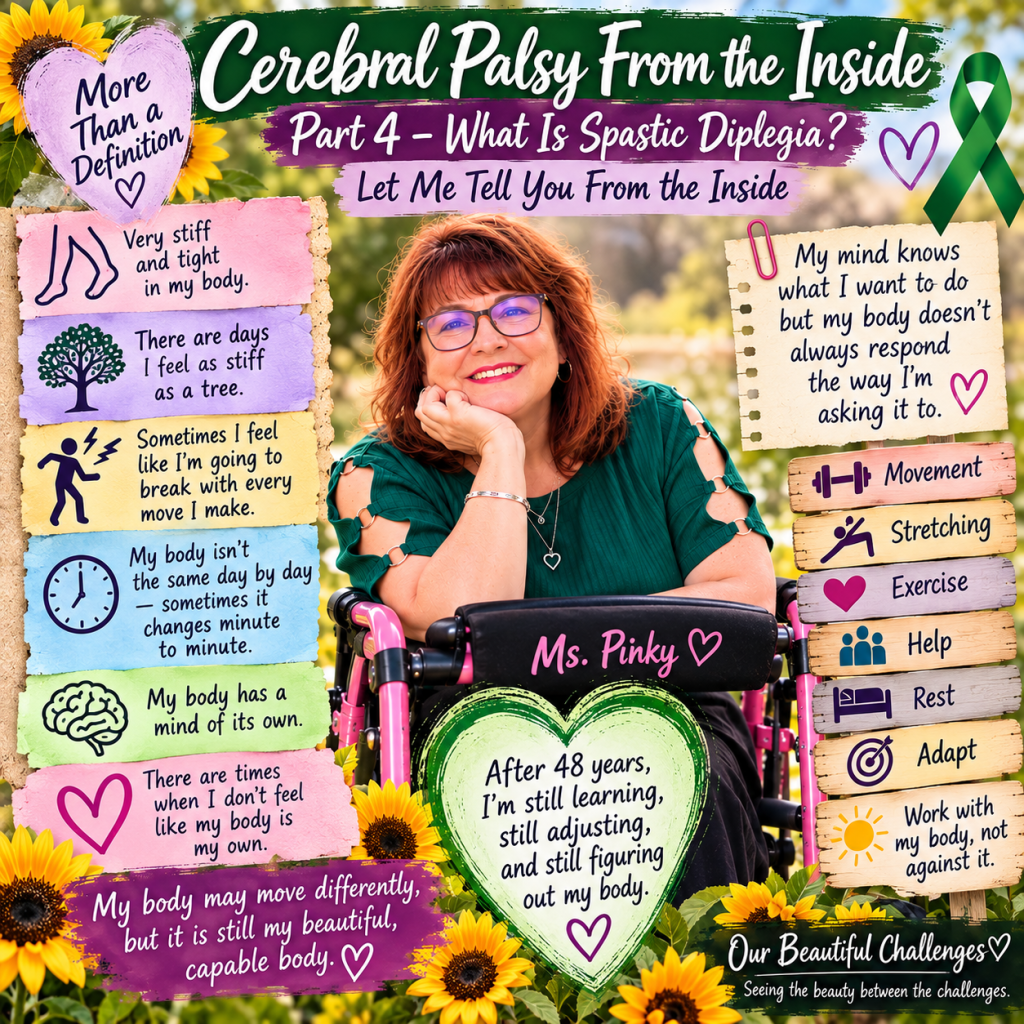
What Is Spastic Diplegia? Let Me Tell You From the Inside
If you look up spastic diplegia, you will probably find a medical explanation telling you that it is a form of cerebral palsy that primarily affects the legs.
That definition is important.
But it doesn’t tell you what it feels like.
I can.
I have lived with spastic diplegia my entire life, and after 48 years, I have learned that there is a big difference between explaining cerebral palsy medically and explaining what it actually feels like to live inside a body with cerebral palsy.
Some Days I Feel as Stiff as a Tree
For me, spastic diplegia can make my body feel very stiff and very tight.
There are days when I feel as stiff as a tree.
Imagine knowing exactly how you want your body to move, but your muscles don’t want to loosen up enough to let you do it easily.
Sometimes the stiffness is so strong that I feel like I’m going to break with every move I make.
Of course, I know I’m not actually going to break.
But that is the best way I can describe the feeling.
Every step can feel harder.
Getting up can feel harder.
Bending can feel harder.
Picking up my feet can feel harder.
Something that another person might do without even thinking about it can require concentration, energy, and determination from me.
A textbook can explain which muscles are affected.
A doctor can explain spasticity.
A physical therapist can measure how my body moves.
But I’m the person who can tell you what it feels like to live inside this body.
My Body Has a Mind of Its Own
One of the hardest things to explain about my cerebral palsy is that my body isn’t the same every day.
Actually, sometimes it isn’t even the same from minute to minute.
My body seems to have a mind of its own.
I can wake up feeling one way and feel completely different a few hours later.
I can start doing something thinking my body is going to cooperate with me, and suddenly it decides otherwise.
Sometimes my mind knows exactly what I want my body to do.
Move your leg.
Pick up your foot.
Take another step.
But my body doesn’t always respond the way I’m asking it to.
And there are times when I don’t even feel like my body is my own.
That can be difficult to explain to someone who has never experienced it.
My mind and my body don’t always seem to be having the same conversation.
After 48 Years, I’m Still Learning My Body
You might think that after living with cerebral palsy for 48 years, I would know exactly what my body is going to do.
I don’t.
That’s one of the most interesting—and sometimes frustrating—things about living with CP.
I’m still learning.
I’m still adjusting.
I’m still figuring things out.
There are days when my body surprises me in a difficult way.
But there are also days when it surprises me in a wonderful way.
Sometimes I accomplish something that I wasn’t sure my body could still do.
Those moments remind me not to underestimate myself.
Learning to Work With My Body
For many years, I thought dealing with cerebral palsy meant pushing my body and fighting against what it couldn’t do.
As I’ve gotten older, I’m beginning to look at it differently.
I’m learning to work with my body instead of always fighting against it.
That means learning when my body needs movement.
When it needs stretching.
When it needs exercise.
When it needs help.
And when it simply needs rest.
I can’t always control what my cerebral palsy is going to give me that day—or even that minute.
But I can decide how I’m going to respond to the body I have in that moment.
Sometimes I can push a little more.
Sometimes I need to adapt.
Sometimes I need to ask for help.
And sometimes the strongest thing I can do is listen when my body tells me, That’s enough for today.
My Body Is Still Capable
My body may be stiff.
My body may be tight.
My body may move differently.
My body may frustrate me.
My body may surprise me.
And sometimes it may feel like it isn’t listening to me at all.
But this is still my body.
This is the body that has carried me through 48 years of life.
The body that has fallen and gotten back up.
The body that has adapted over and over again.
The body that has helped me build an independent life.
And even after all these years, my body and I are still learning how to work together.
That is something you probably won’t find in the medical definition of spastic diplegia.
But that’s why I’m writing Cerebral Palsy From the Inside.
I don’t only want to tell you what cerebral palsy is.
I want to tell you what cerebral palsy feels like when you’re the person living inside the body.
And for me, that story can change from day to day—and sometimes from minute to minute.
💚 Seeing the beauty between the challenges.
— Marie W.O.W.C.P.


Leave a Reply