
Disability Pride Series
Our Beautiful Challenges — Marie
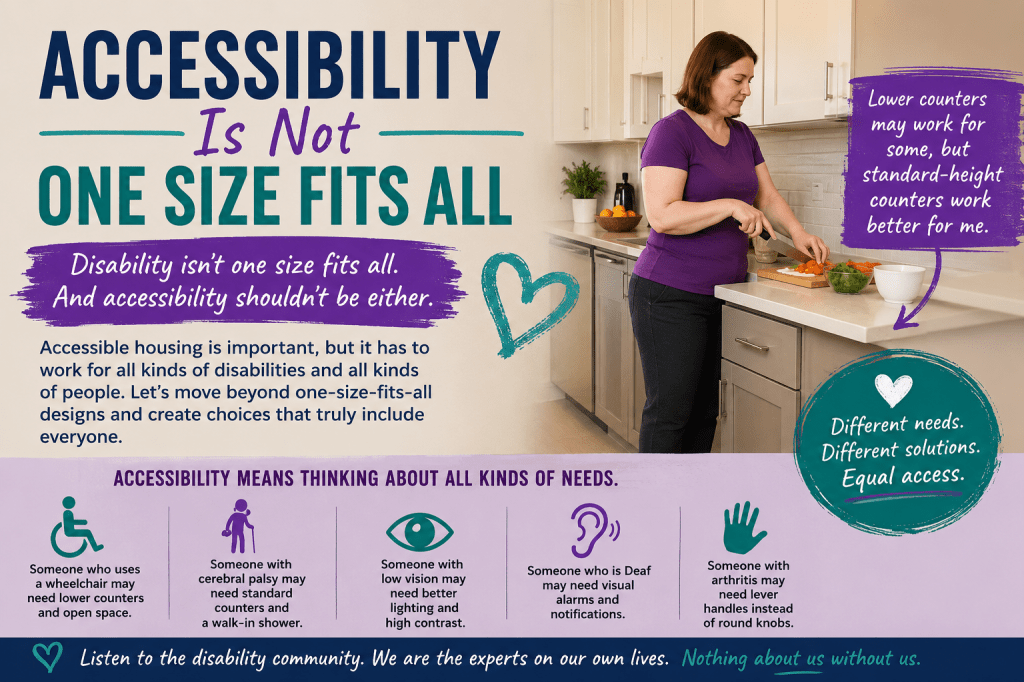
One of the biggest lessons I’ve learned about disability is that accessibility is not one size fits all.
For years, people with disabilities have fought for equal access. The ADA changed our country in incredible ways, making schools, businesses, transportation, and housing more accessible than ever before.
But accessibility is still evolving.
What many people don’t realize is that having an “accessible” apartment doesn’t automatically mean it works for every person with a disability.
Disability is not one experience.
No two disabilities are exactly alike.
Even two people with the same diagnosis may have completely different needs.
Recently, I’ve been thinking a lot about accessible housing.
Many apartment buildings now include ADA-accessible units, and I truly appreciate that progress. Those apartments are life-changing for many people.
But I’ve also realized something important.
Most accessible apartments are designed with wheelchair users in mind.
They often include lower kitchen cabinets and countertops, wider doorways, larger bedrooms, and roll-in or walk-in showers.
Those features are exactly what many wheelchair users need, and they should absolutely continue to be available.
But I’m not a wheelchair user.
I have cerebral palsy, and my needs are different.
A walk-in shower would make a tremendous difference in my life because stepping over the side of a bathtub becomes more difficult as I get older.
A larger bathroom would also make moving around much easier.
But lower kitchen cabinets?
Those actually make cooking more difficult for me because I stand while preparing meals. Standard-height countertops provide better support and are much more comfortable for the way I move.
So while an apartment may be considered “accessible,” it isn’t fully accessible for me.
And that’s the conversation I think we need to start having.
Accessibility shouldn’t be about checking a box.
It should be about recognizing that disability comes in many different forms.
Someone with cerebral palsy may have different needs than someone with multiple sclerosis.
Someone with Parkinson’s disease may need something different than someone with muscular dystrophy.
Someone with a spinal cord injury may have different priorities than someone with arthritis, a brain injury, or a chronic illness.
There isn’t one blueprint that works for everyone.
Instead of asking, “Is this apartment ADA compliant?”
Maybe we should also be asking,
“Who is it accessible for?”
The disability community has so much knowledge to share because we are the experts on our own lives.
If builders, architects, housing developers, and policymakers spent more time listening to people with different disabilities, they would discover that accessibility isn’t about creating one perfect design.
It’s about creating choices.
The goal shouldn’t be one accessible apartment.
The goal should be accessible housing that recognizes the diversity of disability.
As someone living in an apartment building, I see firsthand that accessibility is more than following a checklist. Real accessibility means creating spaces that allow people with different disabilities to live safely, independently, and with dignity.
Because disability isn’t one size fits all.
And accessibility shouldn’t be either.
Sometimes the best solutions don’t come from another building code.
They come from listening to the people who live with disability every single day.


Leave a Reply