Disability Pride Month series
Our Beautiful Challenges — Marie
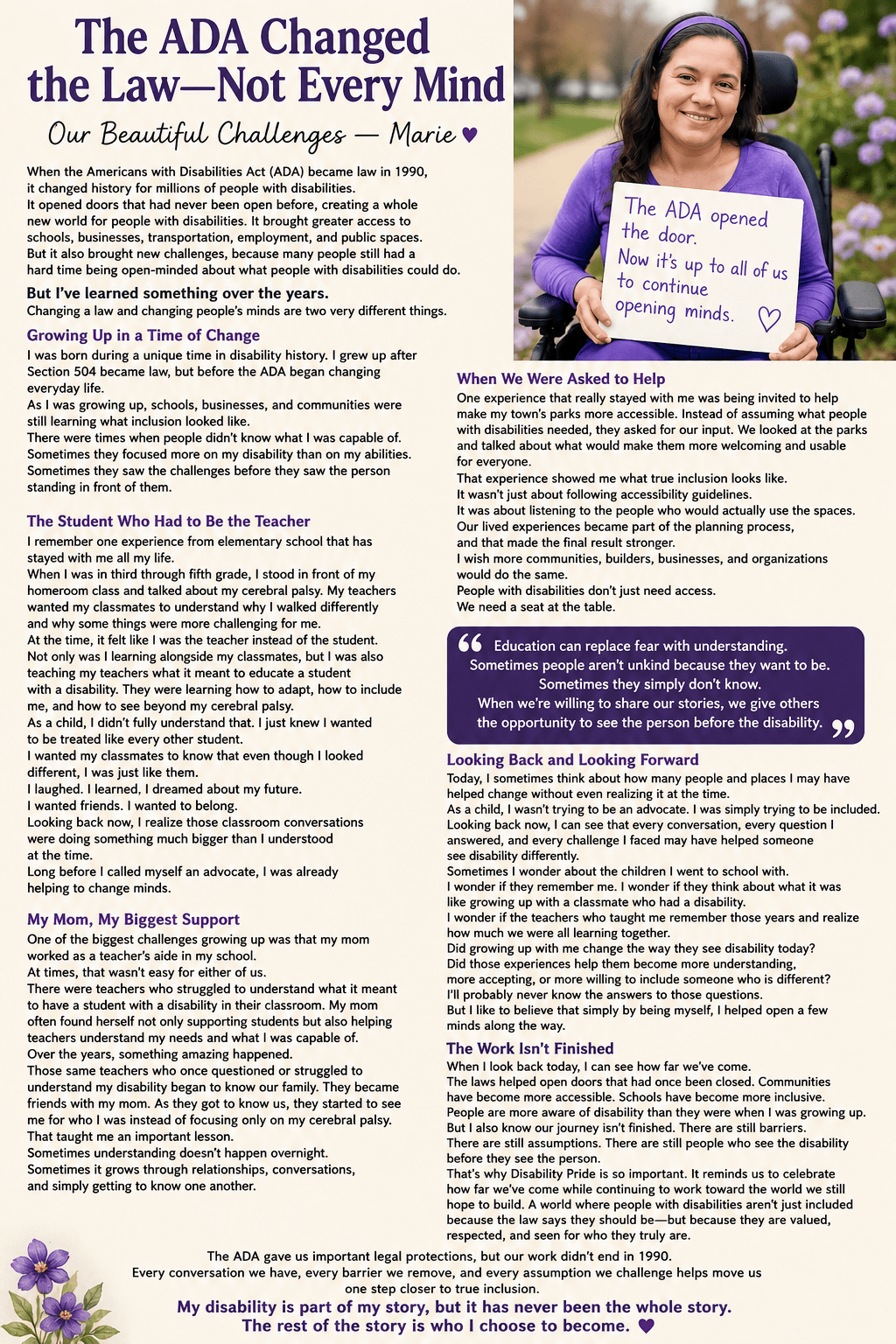
When the Americans with Disabilities Act (ADA) became law in 1990, it changed history for millions of people with disabilities.
It opened doors that had never been open before, creating a whole new world for people with disabilities. It brought greater access to schools, businesses, transportation, employment, and public spaces. But it also brought new challenges, because many people still had a hard time being open-minded about what people with disabilities could do.
Over the years, I’ve learned something important.
Changing a law and changing people’s minds are two very different things.
I was born during a unique time in disability history. I grew up after Section 504 became law, but before the ADA began changing everyday life.
As I was growing up, schools, businesses, and communities were still learning what inclusion looked like.
There were times when people didn’t know what I was capable of.
Sometimes they focused more on my disability than on my abilities.
Sometimes they saw the challenges before they saw the person standing in front of them.
I remember one experience from elementary school that has stayed with me all my life.
From third through fifth grade, I stood in front of my homeroom class and talked about my cerebral palsy. My teachers wanted my classmates to understand why I walked differently and why some things were more challenging for me.
At the time, I felt like I was the teacher instead of the student.
Not only was I learning alongside my classmates, but I was also teaching my teachers and classmates what it meant to include someone with a disability. Looking back, I realize that we were all learning together.
As a child, I didn’t fully understand what those conversations meant.
I just wanted my classmates to know that even though I looked different, I was just like them.
I laughed.
I learned.
I dreamed about my future.
I wanted friends.
Most of all, I wanted to belong.
Looking back now, I realize those classroom conversations were doing something much bigger than I understood at the time.
Long before I ever called myself an advocate, I was already helping to change minds.
One of the biggest challenges growing up was that my mom worked as a teacher’s aide in my school.
At times, that wasn’t easy for either of us.
There were teachers who struggled to understand what it meant to have a student with a disability in their classroom. My mom often found herself not only supporting students but also helping teachers understand my needs and the needs of other students with disabilities, and what we were capable of.
Over the years, something amazing happened.
Those same teachers who once questioned or struggled to understand my disability began to know our family. They became friends with my mom. As they got to know us, they started to see me for who I was instead of focusing only on my cerebral palsy.
That taught me an important lesson.
Sometimes understanding doesn’t happen overnight.
Sometimes it grows through relationships, conversations, and simply getting to know one another.
Another experience that has stayed with me happened years later when I was invited to help make my town’s parks more accessible.
Instead of assuming what people with disabilities needed, the town asked us.
We walked through the parks, talked about accessibility, and shared ideas about what would make those spaces welcoming for everyone.
That experience showed me what true inclusion looks like.
It isn’t just about following accessibility guidelines.
It’s about listening to the people who actually live with disabilities every day.
People with disabilities don’t just need access.
We need a seat at the table.
Today, I sometimes think about how many people and places I may have helped change without even realizing it.
As a child, I wasn’t trying to become an advocate.
I was simply trying to be included.
Looking back now, I can see that every conversation, every question I answered, and every challenge I faced may have helped someone see disability differently.
Sometimes I wonder about the children I grew up with.
I wonder if they remember me.
I wonder if they ever think about what it was like growing up with a classmate who had cerebral palsy.
I wonder if my teachers remember those years and realize how much we were all learning together.
Did growing up with me change the way they see disability today?
Did those experiences help them become more understanding, more accepting, or more willing to include someone who is different?
I’ll probably never know the answers to those questions.
But I’d like to believe that simply by being myself, I helped open a few minds along the way.
When I look back today, I can truly see how far we have come.
The laws helped open doors that had once been closed.
Communities have become more accessible.
Schools have become more inclusive.
People are more aware of disability than they were when I was growing up.
But I also know our journey isn’t finished.
There are still barriers.
There are still assumptions.
There are still people who see the disability before they see the person.
Every day, I still find myself showing people that I am more than my disability.
I’m a writer.
I’m an advocate.
I’m a woman who lives independently.
I’m someone with dreams, goals, and a purpose.
And if I’m honest, there are still days when the person I have to remind the most is myself.
There are days when I have to remind myself that my disability is something I live with—but it is not everything I am.
That’s why Disability Pride is so important.
It reminds us to celebrate how far we’ve come while also recognizing how much work is still ahead of us.
The ADA gave us legal rights.
Now it’s our responsibility to continue changing hearts and minds.
Because true inclusion isn’t just about following the law.
It’s about seeing the person first.
My disability is part of my story, but it has never been the whole story.
The rest of the story is who I choose to become.


Leave a Reply