
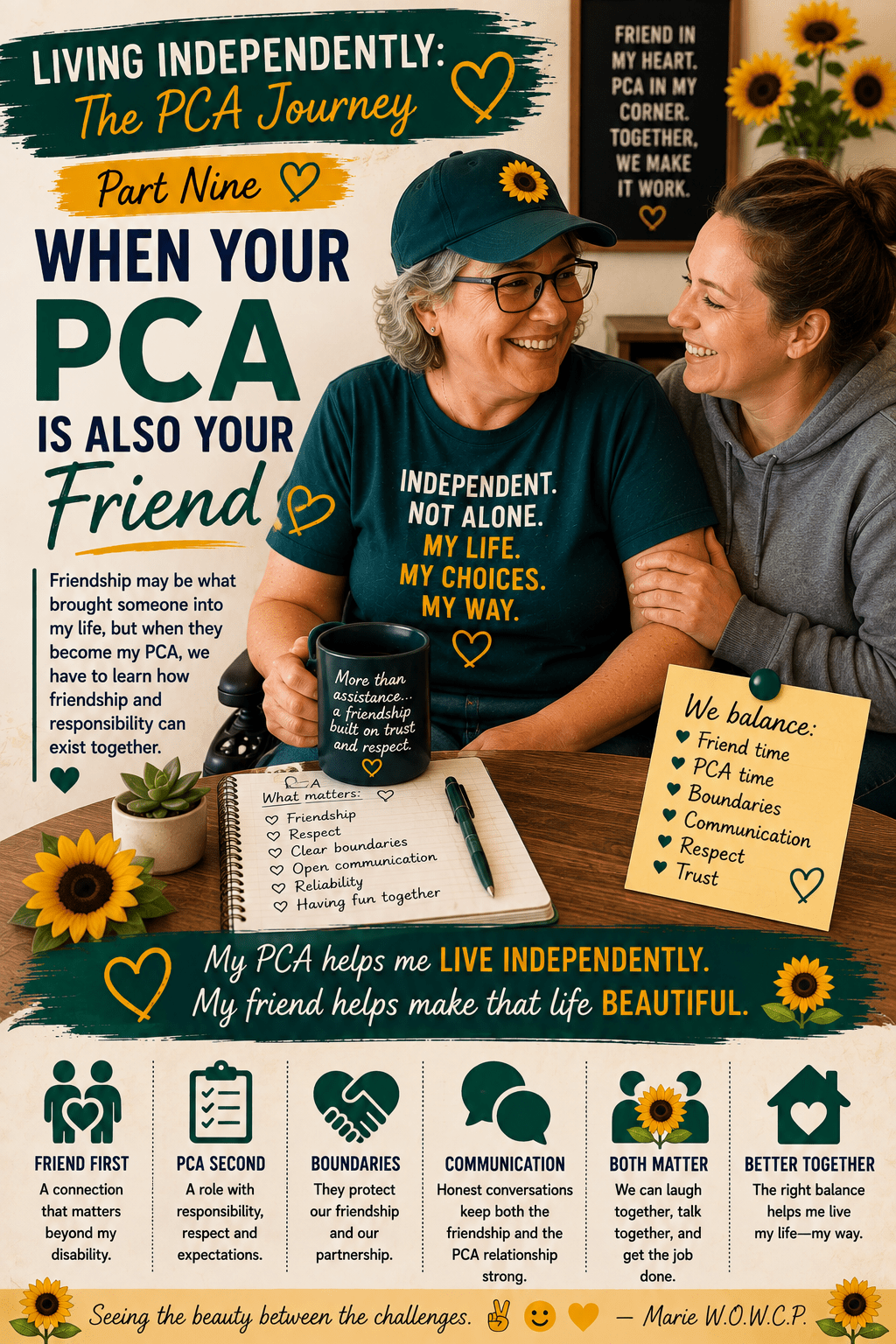
Living Independently: The PCA Journey — Part Nine
Our Beautiful Challenges — Marie W.O.W.C.P.
One of the unique things about being able to choose my own PCAs is that sometimes the person helping me isn’t a stranger.
Sometimes they’re already a friend.
On the surface, that sounds like the perfect situation.
You already know each other.
You already trust each other.
You know each other’s personalities.
You can laugh together, talk about life, and feel comfortable being around each other.
And when someone is going to be involved in personal parts of your everyday life, that comfort can mean a lot.
But I’ve also learned something:
When your friend becomes your PCA, the relationship changes.
They’re still your friend.
But now they’re also working for you.
And figuring out how those two relationships fit together isn’t always easy.
When Friendship and PCA Time Mix
When a PCA is also your friend, there isn’t always a clear line between friendship time and PCA time.
Maybe we’re talking and laughing while something needs to be done.
Maybe we’re out somewhere and it feels like two friends spending the day together, but that person is also there to assist me.
That’s one of the things I actually like about having someone I know as my PCA.
I don’t want every moment of receiving assistance to feel clinical.
I’m a person living my life—not a patient waiting to be cared for.
Having someone around whom I genuinely enjoy can make everyday life feel more natural.
But we still have to remember why they’re there.
Asking a Friend for Help Can Feel Different
This is probably one of the harder parts for me.
When someone is your employee, saying, “I need you to help me with this,” might seem straightforward.
When that employee is also your friend, it can feel different.
Sometimes I don’t want to sound bossy.
I don’t want them to think I’m taking advantage of our friendship.
And because I care about them personally, I may be more aware of what they’re dealing with in their own life.
That can make it tempting for me to say:
“Don’t worry about it.”
But if they’re working as my PCA, I also have to remember that I have needs that must be met.
Being someone’s friend doesn’t mean I have to stop advocating for myself.
I can appreciate my friend and still be their boss when they’re working as my PCA.
Boundaries Become Even More Important
I’ve talked throughout this series about boundaries, but I think they’re especially important when your PCA is also your friend.
We have to figure out what belongs to the friendship and what belongs to the PCA relationship.
There may be things I share with someone because they’re my friend—not because they’re my PCA.
There may also be things they know about me because their PCA role brings them into very personal parts of my life.
That requires trust and respect from both of us.
And just because someone is my friend doesn’t mean there shouldn’t be boundaries.
Actually, sometimes friendship makes those boundaries even more important.
Sometimes We Need to Just Be Friends
I also think there needs to be room for the friendship itself.
I don’t want every interaction with someone I care about to become about my disability or what I need help with.
Sometimes I want to sit and talk.
Sometimes I want to laugh.
Sometimes I want to go somewhere and simply enjoy being with my friend.
My disability is part of my life, but it isn’t the only thing that connects me to the people I care about.
That’s important to remember.
A PCA may help me because of my disability. A friend is with me because of who I am.
When someone is both, we have to make room for both relationships.
Friendship Doesn’t Replace Responsibility
At the same time, being friends doesn’t mean PCA responsibilities disappear.
If someone is working with me as a PCA, we still need communication.
We still need expectations.
We still need reliability.
And I still need to be able to speak up when something isn’t working.
That’s probably one of the biggest challenges of hiring someone you care about.
You don’t want a work disagreement to damage the friendship.
But avoiding every difficult conversation can damage the relationship too.
Sometimes respecting a friendship means being willing to communicate honestly.
It Can Be Something Really Special
There are challenges when a PCA is also a friend.
But there can also be something really special about it.
You’re receiving assistance from someone who already knows there’s much more to you than your disability.
They know your personality.
They know what makes you laugh.
They know when you’re frustrated.
They may know when you need encouragement—and when you just need someone to let you figure something out yourself.
That kind of understanding can take time to build with a new PCA.
With a friend, some of it may already be there.
Finding the Balance
I don’t think there’s one perfect way to have a friend also be your PCA.
Every friendship is different.
Every PCA relationship is different.
And the boundaries that work for one person may not work for another.
What matters is finding the balance that works for both people.
There needs to be friendship.
There needs to be respect.
There needs to be communication.
And when PCA work is involved, there also needs to be responsibility.
I’ve learned that I don’t have to choose between having a good PCA relationship and having a real friendship.
The two can exist together.
But both people have to understand when it’s time to be friends—and when it’s time to put on the PCA hat.
My PCA may help me live independently.
My friend helps make that independent life a little more enjoyable.
And when I’m lucky enough to have someone who can be both, that’s a relationship worth taking care of.
✌️ 😊 💛
Seeing the beauty between the challenges.
— Marie W.O.W.C.P.


Leave a Reply