
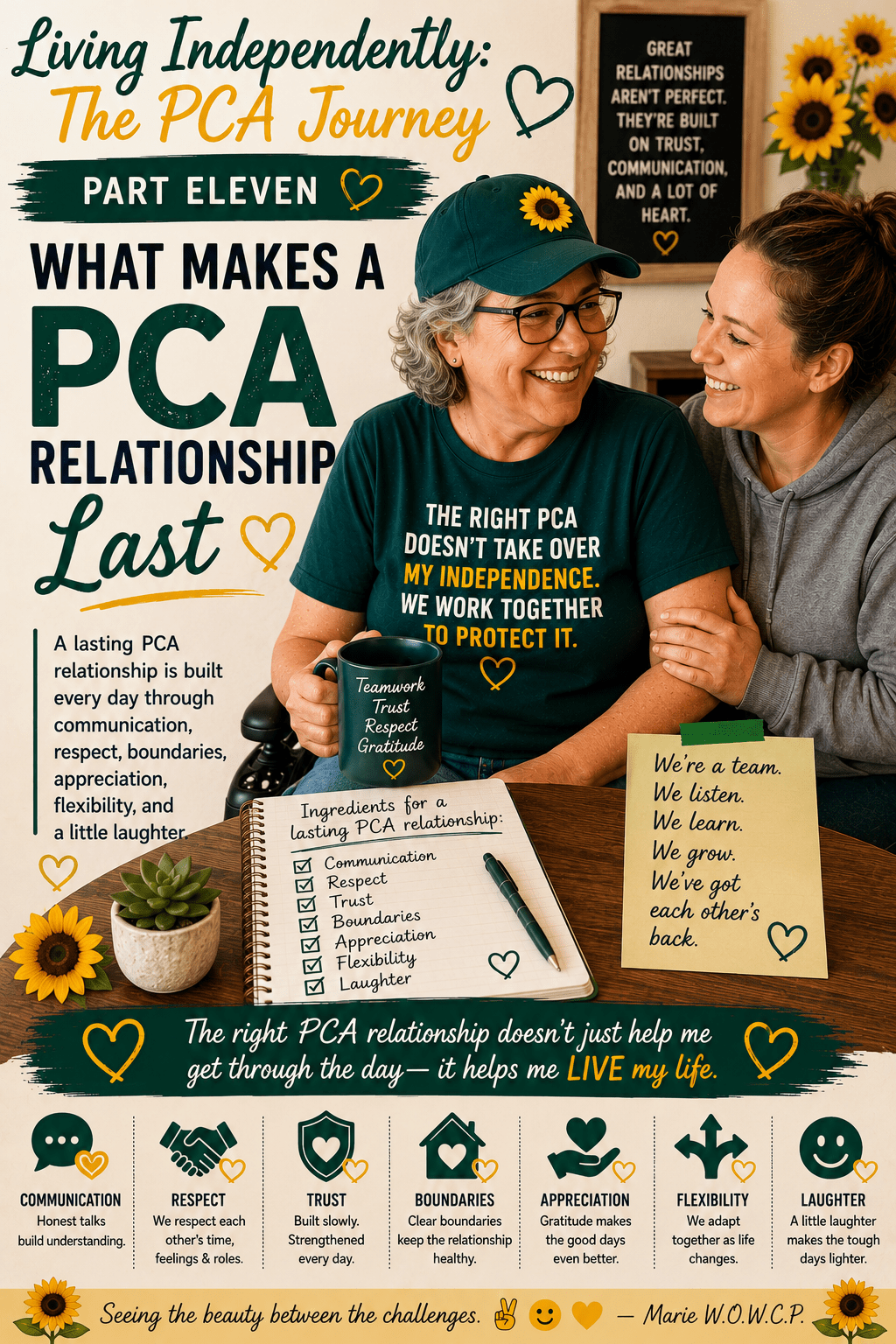
What Makes a PCA Relationship Last
Living Independently: The PCA Journey — Part Eleven
Our Beautiful Challenges — Marie W.O.W.C.P.
Finding the right PCA is one thing.
Building a relationship that lasts is something else.
Throughout this series, I’ve talked about trust, boundaries, friendship, communication, and even what happens when a PCA isn’t the right match.
But when you do find someone who works well with you, what keeps that relationship going?
For me, I don’t think there’s one answer.
A good PCA relationship is something both people build.
Communication Has to Keep Happening
Good communication isn’t something you establish during the first few weeks and then forget about.
Needs change.
Routines change.
Life changes.
And sometimes what worked six months ago doesn’t work anymore.
I have to be able to tell my PCA when I need something different.
My PCA also needs to feel comfortable communicating with me.
That doesn’t mean we’re always going to agree.
It means we’re willing to talk.
Sometimes the smallest conversation can prevent a much bigger problem later.
Respect Has to Go Both Ways
I talk a lot about wanting my PCAs to respect me, my home, my choices, and my boundaries.
But if I want a PCA relationship to last, I also have to give respect.
My PCA is a person too.
They have responsibilities outside of working with me.
They have good days and bad days.
They have feelings.
Being the boss doesn’t mean I get to forget that.
At the same time, being kind and understanding doesn’t mean ignoring my own needs.
A lasting relationship needs mutual respect.
Trust Continues to Grow
I’ve said before that trust doesn’t come with the job title.
It’s built.
And even after you trust someone, that trust continues to grow.
Every time someone shows up when they say they will, trust grows.
Every time they listen to me, trust grows.
Every time I can communicate something difficult and know I’m being heard, trust grows.
Over time, you start learning each other’s rhythms.
Sometimes a PCA may know what I need before I even have to explain everything.
That’s something that can only happen with time and experience.
Boundaries Keep the Relationship Healthy
Boundaries aren’t there to push people away.
They’re there to help relationships work.
This is especially important when a PCA becomes a friend or was already a friend before becoming a PCA.
There still has to be an understanding of roles.
There are times to laugh and talk.
There are times when something needs to get done.
There are things I’m comfortable sharing.
There may be other things I want to keep private.
Those boundaries can be different with every PCA.
The important thing is that we both understand and respect them.
Appreciation Matters
I don’t ever want the people helping me to feel like I take them for granted.
Yes, they’re doing a job.
But they’re also helping me live the independent life I’ve worked hard to create.
Sometimes simply saying “thank you” matters.
Sometimes acknowledging that someone went above and beyond matters.
People want to know their work is appreciated.
I know I do.
So I try to remember that the people working with me deserve that same appreciation.
We Have to Be Able to Laugh
This might not sound like an important ingredient in a professional relationship, but for me it is.
Life is serious enough.
Disability can bring frustrating moments.
There are days when my body doesn’t cooperate.
There are days when plans change.
There are days when something that should take five minutes takes much longer.
Being able to laugh together can make those moments easier.
I don’t want my PCA relationship to feel like everything revolves around what I can’t do.
I want to be myself.
And sometimes being myself means laughing until something that frustrated me five minutes ago doesn’t feel quite so overwhelming anymore.
We Both Have to Be Willing to Adapt
People change.
My needs may change.
A PCA’s life may change.
Schedules may change.
My body may change.
That’s why flexibility matters.
A long-lasting PCA relationship can’t stay exactly the same forever.
We have to be willing to adjust while still respecting each other’s needs and boundaries.
Sometimes that means changing a routine.
Sometimes it means having a conversation.
Sometimes it means figuring out a completely new way of doing something.
That’s part of working together.
The Best PCA Relationships Feel Like a Team
When I think about the PCA relationships that work best, one word keeps coming back to me:
Teamwork.
I’m not looking for someone to take over my life.
I’m looking for someone who can work beside me.
I bring something important to that team: I know myself.
I know my body.
I know my goals.
I know what kind of life I want.
My PCA brings their own strengths, personality, abilities, and support.
When those things work together, something really good can happen.
The relationship becomes about more than completing tasks.
It becomes a partnership built around helping me continue living my life.
A Relationship Worth Building
A good PCA relationship doesn’t last because everything is perfect.
There will be misunderstandings.
There will be frustrating days.
There will be times when one of us could have communicated better.
What matters is what happens afterward.
Do we talk?
Do we listen?
Do we respect each other?
Do we learn?
Do we keep trying?
That’s what makes a relationship last.
Trust. Communication. Boundaries. Respect. Appreciation. Flexibility. And yes, a little laughter.
When those things are there, a PCA can become an important part of your team.
And when you find that kind of relationship, it’s worth taking care of.
Because the right PCA doesn’t take over my independence.
We work together to protect it.
✌️ 😊 💛
Seeing the beauty between the challenges.
— Marie W.O.W.C.P.


Leave a Reply