
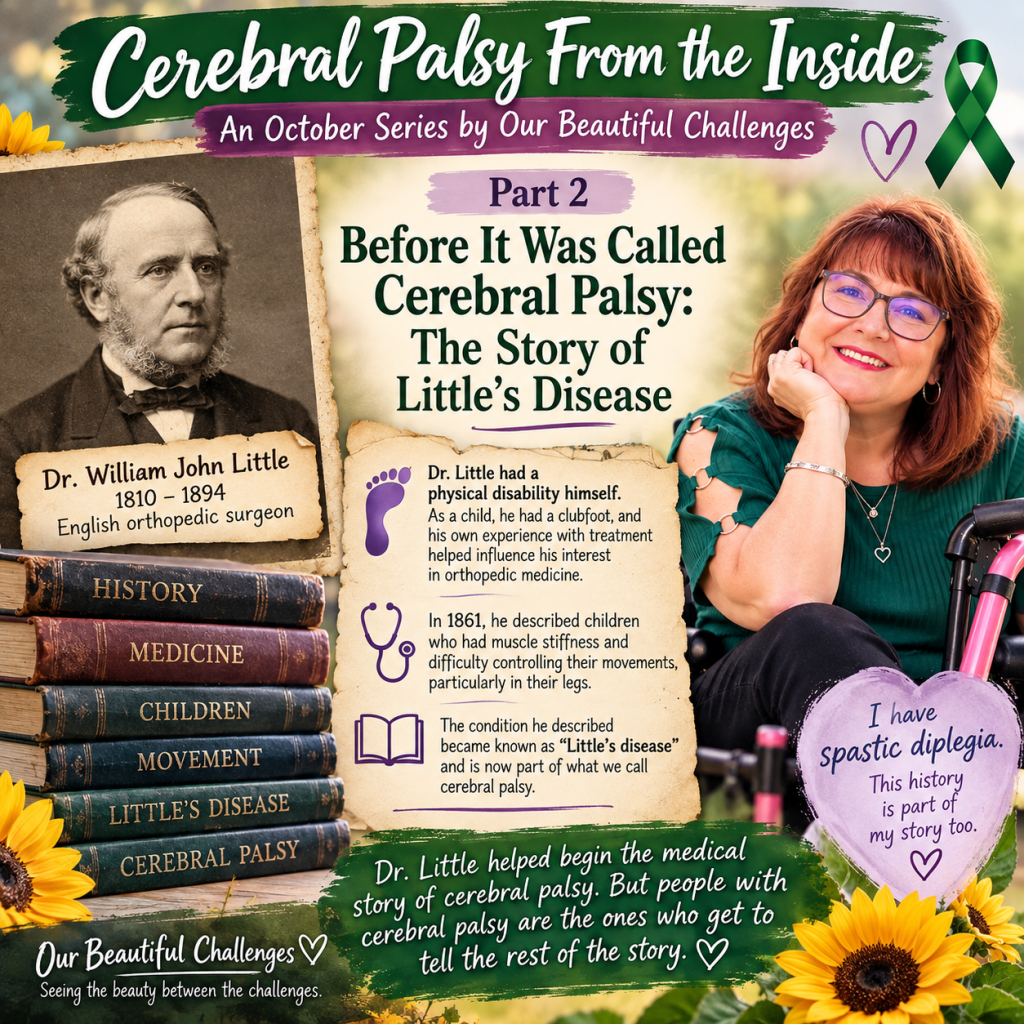
Cerebral Palsy From the Inside — Part 2
Before It Was Called Cerebral Palsy: The Story of Little’s Disease
For my entire life, I have known my disability by two words: cerebral palsy.
But while researching the history of CP for this October series, I discovered something I had never known before.
Before cerebral palsy had the name we use today, one of the doctors who helped medicine begin to understand it was Dr. William John Little.
And the more I learned about him, the more interesting his story became.
The Part of His Story I Never Knew
One thing that really surprised me was learning that Dr. Little had a physical disability himself.
As a child, he had a clubfoot. He eventually sought treatment for it, and his own experiences helped influence his interest in orthopedic medicine.
I had never known this.
Here was a doctor who would eventually become an important person in the history of cerebral palsy, and he already understood something about living in a body that moved differently.
Of course, his experience was not the same as living with cerebral palsy. But learning this made me look at his story differently.
It made me wonder:
Did his own experience with disability change the way he looked at the children he studied?
Did he understand something about being physically different that another doctor of his time might not have understood?
We can’t know exactly what he felt. But I find it interesting that someone whose name became connected to my disability also had his own experience with a physical difference.
What Was “Little’s Disease”?
In the 1800s, Dr. Little studied children who experienced muscle stiffness and difficulty controlling their movements, particularly in their legs.
In 1861, he presented important work describing these movement difficulties. The condition he described eventually became associated with his name and was sometimes called Little’s disease.
Today, we know this as part of what we call cerebral palsy.
What makes this history even more personal for me is that Dr. Little’s work became particularly associated with spastic diplegia, where the legs are generally affected more than the arms.
I have spastic diplegia.
Suddenly, I wasn’t simply researching medical history.
I was researching part of my own history.
Dr. Little could describe how children’s muscles behaved. He could study their legs and observe the way they moved.
But there was something medicine couldn’t measure.
He couldn’t know the lives those children would eventually lead.
He couldn’t measure their dreams.
He couldn’t measure their determination.
He couldn’t measure their ability to adapt.
And he couldn’t look more than 160 years into the future and see people with cerebral palsy going to college, working, falling in love, living independently, traveling, exercising, advocating, writing, and telling their own stories.
More than a century after Dr. Little helped medicine begin to understand bodies like mine, I get to tell you what living in one of those bodies is actually like.
Dr. Little helped begin the medical story of cerebral palsy.
But people with cerebral palsy are the ones who get to tell the rest of the story.
💚 Seeing the beauty between the challenges.
— Marie W.O.W.C.P.


Leave a comment