
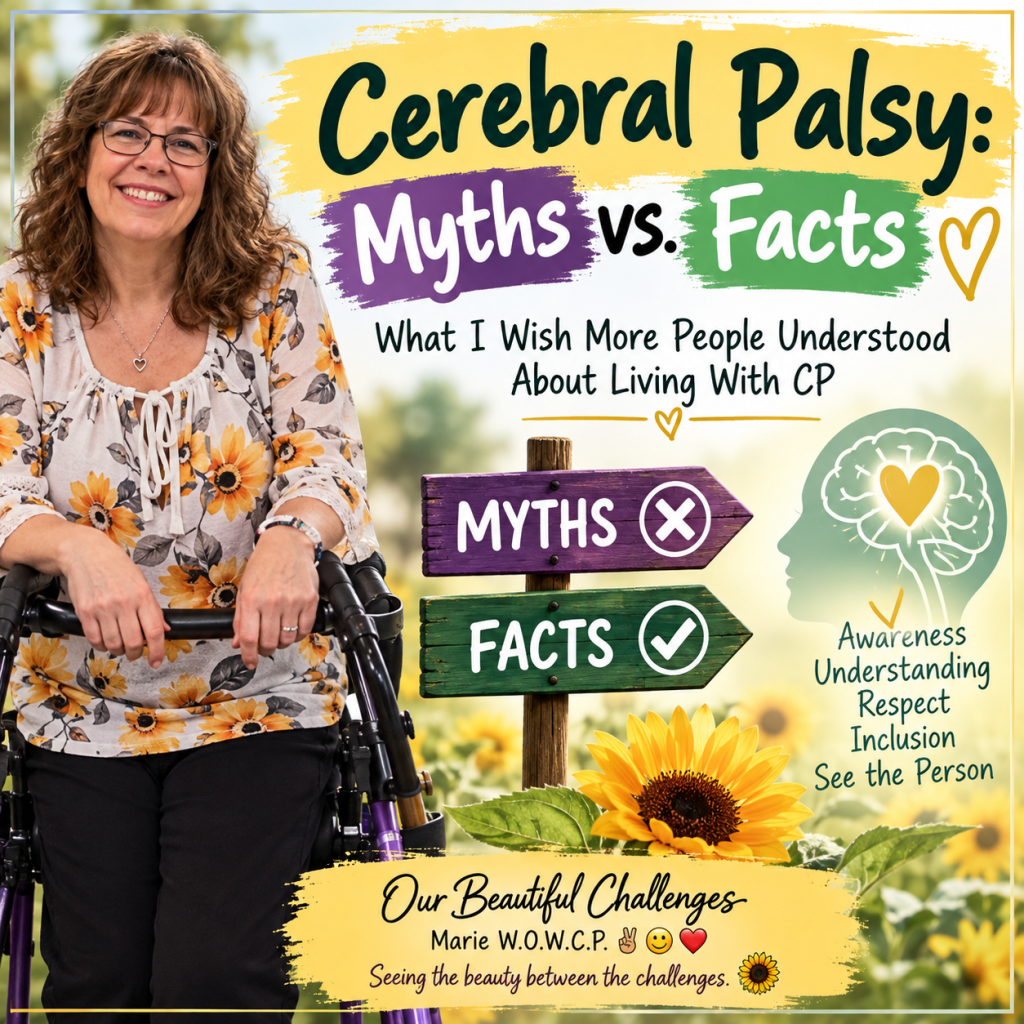
What I Wish More People Understood About Living With CP
There are many myths about cerebral palsy.
Some come from people simply not knowing much about the disability. Others come from assumptions people have made for generations about what someone with a disability can and cannot do.
As someone who has lived with cerebral palsy my entire life, I’ve heard many of them.
Sometimes people see the walker.
Sometimes they hear the way someone speaks.
Sometimes they notice how a person’s body moves.
And before getting to know the person, they have already decided what that person can understand, accomplish, or experience in life.
So I want to challenge some of those assumptions.
Because cerebral palsy affects everyone differently.
MYTH #1: Everyone with cerebral palsy is the same.
FACT: Cerebral palsy affects every person differently.
Some people walk independently. Some use walkers or crutches. Some use wheelchairs. CP can affect movement, coordination, balance, posture, speech, and other areas differently from one person to another.
There isn’t one way to “look” like you have cerebral palsy.
If you’ve met one person with cerebral palsy, you’ve met one person with cerebral palsy.
MYTH #2: Cerebral palsy gets progressively worse.
FACT: Cerebral palsy itself is considered non-progressive. The original injury or difference in the developing brain doesn’t continue getting worse.
But that doesn’t mean our bodies never change.
We age just like everyone else.
Years of moving differently can affect our muscles and joints, and some adults with CP experience changes in pain, fatigue, mobility, strength, and endurance as they get older.
I’ve learned that saying “CP doesn’t get worse” doesn’t tell the whole story of what aging in a body with cerebral palsy can feel like.
MYTH #3: If someone has difficulty speaking, they must have difficulty understanding.
FACT: Speech and intelligence are not the same thing.
Someone may have difficulty physically producing speech while understanding exactly what is being said.
Never assume someone’s intelligence based on the way they speak.
Give people time to communicate.
And most importantly, listen.
MYTH #4: Using a walker or wheelchair means someone isn’t independent.
FACT: Mobility equipment can actually create independence.
My walker helps me safely get where I want to go.
Independence isn’t about refusing equipment or refusing help.
It’s about having the tools and support you need to live your own life.
MYTH #5: Adults with cerebral palsy don’t need continued support.
FACT: Children with cerebral palsy grow into adults with cerebral palsy.
Our needs don’t magically disappear when we turn 18.
Adults may continue to need accessible healthcare, therapy, mobility equipment, personal assistance, exercise programs, transportation, accommodations, or other services.
We need more conversations about adults aging with cerebral palsy.
MYTH #6: People with cerebral palsy can’t exercise.
FACT: Many people with CP can and do exercise.
Exercise may look different and may need to be adapted to the person’s abilities.
For me, movement is an important part of taking care of myself. I’ve participated in chair yoga, Pilates, tai chi, and other adapted movement classes.
I don’t have to exercise exactly like someone without cerebral palsy for movement to benefit my body.
MYTH #7: Cerebral palsy defines the person.
FACT: Cerebral palsy is part of who I am, but it isn’t everything I am.
I’m a woman.
I’m a writer.
I’m a partner.
I’m a friend.
I’m an advocate.
I’m a person with dreams, goals, opinions, interests, and a life of my own.
And yes, I’m also a woman with cerebral palsy.
You can acknowledge my disability without making it my entire identity.
MYTH #8: People with cerebral palsy can’t be educated.
FACT: Having cerebral palsy doesn’t determine someone’s ability to learn.
Some people with CP also have intellectual or learning disabilities, while others do not. Every person is different.
Growing up, learning wasn’t always easy for me.
It took me longer to learn certain things, including reading.
But taking longer didn’t mean I couldn’t learn.
I went on to college and earned an associate degree in Human Services and a certificate in Recreation Therapy.
My cerebral palsy never meant I wasn’t capable of being educated.
Sometimes the biggest barrier isn’t someone’s ability to learn.
It’s other people’s assumptions about what they’re capable of learning.
MYTH #9: People with cerebral palsy can’t work.
FACT: Having cerebral palsy doesn’t automatically mean someone can’t work.
People with CP work in many different careers. Some may need accommodations, adapted equipment, flexible schedules, personal assistance, or other support.
I went to college because I wanted a career helping people.
I worked in recreation therapy and as a teacher assistant in a transition classroom.
Eventually, my body could no longer keep up with the physical demands of working.
I wish I could have worked longer.
But the number of years I was able to work doesn’t take away from what I accomplished or what I contributed.
Having a disability doesn’t determine whether someone has something valuable to offer.
MYTH #10: People with cerebral palsy can’t get married or have sexual relationships.
FACT: Cerebral palsy doesn’t take away someone’s ability to love, be loved, experience attraction, have intimate relationships, or get married.
People with CP date.
We fall in love.
We have partners.
We can marry.
We can have fulfilling intimate and sexual relationships.
For many years, I wondered whether love and having a life partner would ever happen for me.
It took longer than I expected, but I found love on my timeline.
Having a physical disability doesn’t make someone less deserving of intimacy, companionship, or love.
Disability doesn’t make someone less capable of loving or being loved.
MYTH #11: People with cerebral palsy can’t have children.
FACT: Cerebral palsy doesn’t automatically prevent someone from becoming a parent.
Some people with CP have biological children. Pregnancy and childbirth may require individualized medical care depending on the person’s health and how CP affects their body.
Others become parents through adoption or other paths.
Some decide they don’t want children.
And some people with CP, just like people without disabilities, may experience fertility problems.
There isn’t one story.
Cerebral palsy doesn’t determine whether someone can create a family.
Families come in many different forms.
MYTH #12: People with cerebral palsy can’t live independently.
FACT: Independence doesn’t mean doing absolutely everything by yourself.
Someone with cerebral palsy may live independently while using PCAs, mobility equipment, accessible transportation, family support, or other services.
I live in my own apartment.
There are things I can do independently and things I need assistance with.
Receiving support doesn’t take away my independence.
In many ways, having the right support is what makes my independence possible.
Independence isn’t about doing everything alone. It’s about having choices and control over your own life.
MYTH #13: If you can walk, your cerebral palsy must be mild.
FACT: You can’t determine how cerebral palsy affects someone simply by watching them walk.
Someone may be able to walk while also experiencing muscle tightness, balance difficulties, fatigue, pain, coordination challenges, or other issues.
You also don’t see how much energy it may take someone to accomplish something that looks simple from the outside.
What you see during a few minutes with someone doesn’t necessarily tell you what their body experiences throughout an entire day.
MYTH #14: Cerebral palsy only affects children.
FACT: Children with cerebral palsy become adults with cerebral palsy.
There is a lot of attention placed on children with CP, which is important.
But we don’t stop having cerebral palsy when we become adults.
Our bodies continue aging.
Our circumstances change.
And sometimes our support needs change too.
Adults with cerebral palsy deserve healthcare, research, resources, and conversations about what aging with CP actually looks like.
MYTH #15: People with cerebral palsy must be unhappy because they’re disabled.
FACT: Having a disability doesn’t mean someone can’t have a happy and meaningful life.
Are there difficult days?
Absolutely.
Are there things about cerebral palsy I wish were easier?
Of course.
But my life also contains love.
Friendship.
Writing.
Exercise.
Faith.
Travel.
Laughter.
Independence.
Goals.
And plenty of ordinary moments that bring me happiness.
I don’t have to pretend cerebral palsy is easy to appreciate the life I’ve built.
I can acknowledge the challenges and still see the beauty between them.
Don’t Decide My Life by Looking at My Disability
If there is one thing I want people to understand after reading these myths and facts, it’s this:
Don’t look at cerebral palsy and decide what someone’s life can be.
Don’t decide whether we’re intelligent.
Don’t decide whether we can work.
Don’t decide whether we can live independently.
Don’t decide whether we can fall in love.
Don’t decide whether we can have sex, marry, become parents, have careers, or build meaningful lives.
Ask us.
Listen to us.
Get to know us.
Because we are the experts on our own lives.
Cerebral palsy is part of my story.
It has shaped many of my experiences, and I’m no longer interested in pretending it isn’t there.
But it has never been the only thing there is to know about me.
See the cerebral palsy. But then keep looking.
There’s an entire person behind it.
— Marie W.O.W.C.P. ✌️😊❤️
Seeing the beauty between the challenges. 🌻💛


Leave a comment