
What Independence Looks Like With Cerebral Palsy
Independence is important to many people in the disability community.
For me, as a woman with cerebral palsy, independence has been one of the most important goals of my life.
But I’ve also learned that independence doesn’t always look the way people think it does.
My Mind and My Body Don’t Always Tell the Same Story
Cerebral palsy affects every person differently.
For me, one of the difficult things about living with CP is that I know what I want to do and how I want to live my life, but my body sometimes needs assistance to make those things possible.
In some ways, it can feel like being stuck between a rock and a hard place.
My body may need help.
But I am still the person making the decisions.
That distinction is important.
Needing physical assistance doesn’t mean someone isn’t capable of making choices about their own life.
Independence Doesn’t Mean Doing Everything Alone
For a long time, I thought independence meant being able to do as much as possible by myself.
I had wanted independence for so long that when I finally had it, I didn’t want anything to take it away from me.
That’s why accepting more help wasn’t always easy.
When I first started getting support from PCAs, part of me worried that I was going to lose some of my independence.
I thought needing another person to help me meant I was becoming more dependent.
What actually happened surprised me.
I didn’t lose independence when I accepted PCA support. I gained more independence.
My PCAs Help Me Do More, Not Less
My PCAs help me with physical things that take more energy or are difficult for my body.
That leaves me with more energy for the things that matter to me.
They can help me take care of my home.
They can help me get ready.
They can help me with everyday tasks.
But they aren’t making my decisions for me.
I’m still the one directing my life.
I’m deciding what I need help with.
I’m deciding what I want to do.
I’m deciding where I want to go.
I’m deciding how I want my home and my life to work.
My PCAs aren’t taking independence away from me.
They’re helping make my independence possible.
That was a completely different way of looking at support.
The Same Is True of My Walker
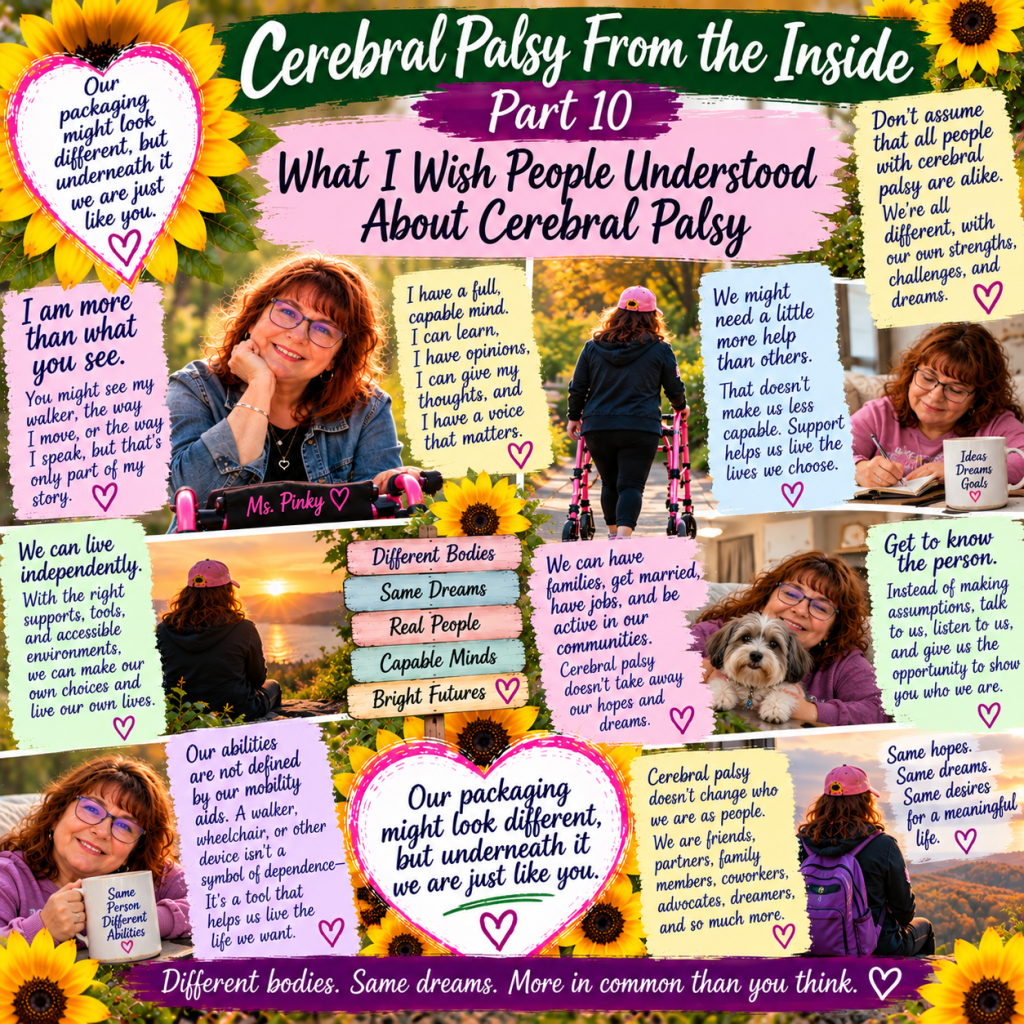
I use my walker, Ms. Pinky, to help me move around safely.
Other people with cerebral palsy may use wheelchairs, crutches, communication devices, adaptive equipment, or other mobility aids.
Sometimes society looks at these things and sees dependence.
I see them differently.
They’re tools for independence.
If Ms. Pinky helps me safely get from one place to another, she isn’t limiting my independence.
She’s helping me live it.
My Own Home Changed Everything
For years, I wanted to live independently.
Eventually, I moved into my own apartment.
Getting my own place didn’t suddenly make cerebral palsy disappear.
I still needed help.
I still needed my walker.
I still needed transportation.
I still needed accessible equipment.
But something very important changed.
It was my home.
I could make decisions about my own day.
I could create a home that looked like me.
I could decide when I wanted company and when I wanted quiet.
I could build routines that worked with my body.
And eventually, I learned that allowing other people to help me in my home didn’t make that home—or my life—any less mine.
Support Can Protect Independence
This may be one of the biggest lessons I’ve learned since living on my own:
Sometimes accepting help is exactly what allows me to remain independent.
Using a walker doesn’t take away my independence if that walker helps me get where I want to go.
Having a PCA doesn’t take away my independence if that assistance helps me live safely in my own home.
Making my home more accessible doesn’t make me less capable.
It allows me to use my capabilities.
And resting when my body needs it doesn’t mean I’m giving up my independence either.
It means I’m trying to protect it.
This Is What Independence Looks Like for Me
My independence may not look like someone else’s.
That’s okay.
I use a walker.
I have PCAs.
I use accessible transportation.
I need help with certain things.
And I live my own life.
All of those things can be true at the same time.
I used to think accepting more support might mean losing some of the independence I had worked so hard to achieve.
Instead, support gave me the freedom to become even more independent.
That’s something I wish I had understood much earlier.
Independence isn’t proving that I can do everything alone.
Independence is having control over the direction of my own life and having the support I need to keep living it.
💚 Seeing the beauty between the challenges.
— Marie W.O.W.C.P.


Leave a Reply