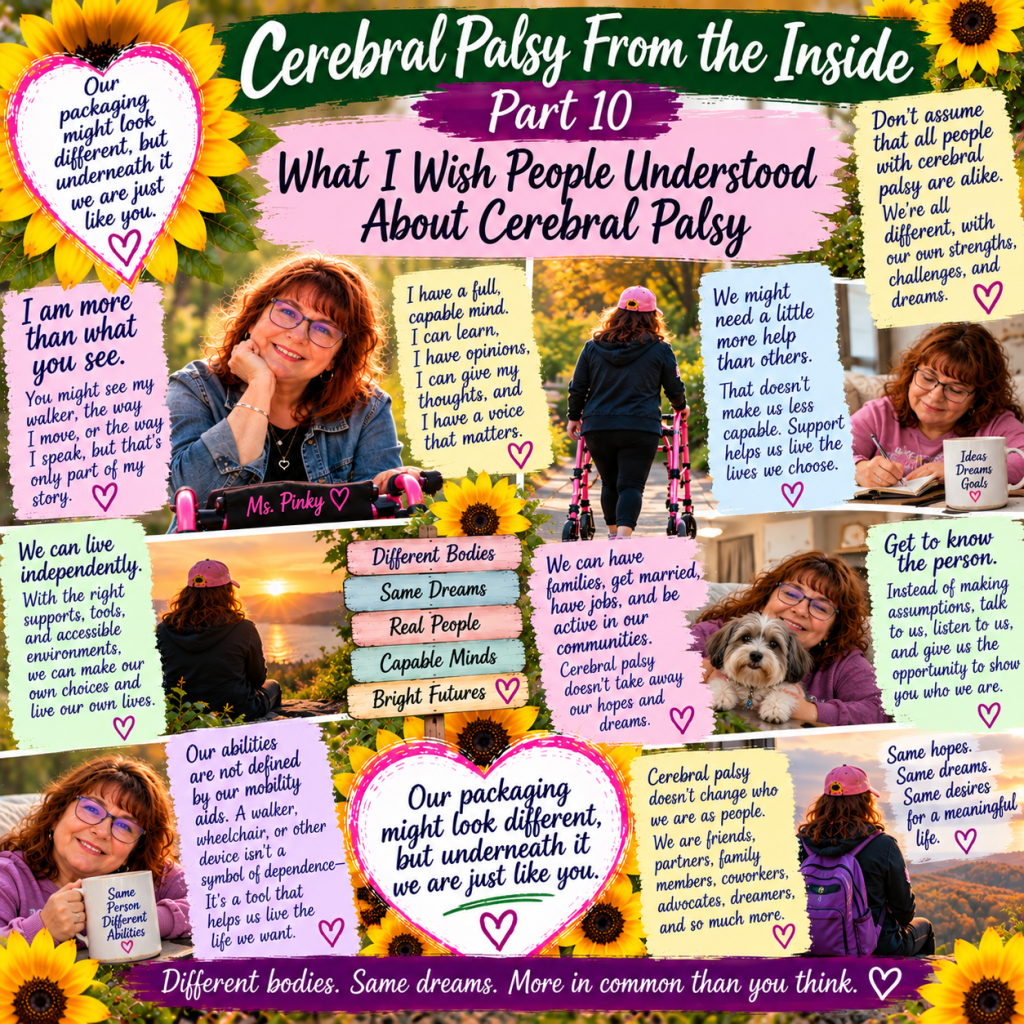
What I Wish People Understood About Cerebral Palsy
If there is one thing I wish people understood about cerebral palsy, it is this:
Please don’t assume you know who we are just by looking at us.
One of the biggest mistakes people make is assuming that all people with cerebral palsy are alike.
We’re not.
Cerebral palsy affects every person differently.
Our bodies may move differently.
Some of us walk.
Some of us use walkers.
Some use wheelchairs.
Some communicate differently.
Some need more assistance than others.
But none of those things tell you everything about the person inside.
We Are More Than What You See
I’ve often thought about disability as the packaging people see first.
My packaging might look different from yours.
You might see my walker.
You might notice the way I move.
You might hear the way I speak.
You might notice my cerebral palsy before you notice anything else about me.
But my packaging isn’t the whole person.
Behind what you see is Marie.
I have thoughts.
I have opinions.
I have ideas.
I have dreams.
I have a sense of humor.
I have people I love.
I have things that frustrate me and things that make me happy.
I’m a whole person before I’m a diagnosis.
Don’t Assume What Someone Can Understand
This is especially important to me.
You cannot look at someone’s body and automatically know what that person understands.
For me, cerebral palsy affects my body in ways that people can see.
Sometimes I need physical assistance.
But needing help physically doesn’t mean someone should assume what I can or cannot think, learn, understand, or contribute.
People with cerebral palsy have different abilities and different support needs, just like everyone else.
Get to know the person before deciding what they’re capable of.
Talk to us.
Listen to us.
Ask us what we need instead of assuming.
And most importantly, give us an opportunity to answer for ourselves.
We Want Lives Too
People with cerebral palsy can have dreams for their lives.
We can pursue education.
We can work.
We can live independently with the right supports.
We can fall in love.
We can get married.
We can have families.
We can have friendships.
We can travel.
We can participate in our communities.
We can have goals for the future.
And yes, some of us may need assistance while doing those things.
Needing assistance doesn’t make those lives less meaningful.
I’ve learned that lesson through my own independence.
I use a walker.
I have PCAs.
I use accessible transportation.
There are things I need help doing.
None of those things erase the life I’ve built.
In many ways, those supports are what allow me to keep living it.
Different Doesn’t Mean Less
I think sometimes people see disability and immediately concentrate on what appears different.
I understand why.
My cerebral palsy is visible.
You can see that I move differently before you know anything else about me.
But I wish people would become curious about the person instead of making assumptions about the disability.
Ask me what I like.
Ask me what I’ve done.
Ask me what I’m interested in.
Ask me about my writing.
Ask me about the people I love.
Ask me about my dreams.
You might discover that we have much more in common than you expected.
See Beyond the Packaging
My body is part of my story.
Cerebral palsy is part of my story.
I’m not ashamed of either one.
But neither tells you everything there is to know about me.
Our packaging might look different, but underneath it we are people who want many of the same things everyone else wants—to be respected, included, loved, heard, and given the opportunity to live our lives.
So when you meet someone with cerebral palsy, don’t assume you already know their story.
Don’t assume what they can or cannot do.
Don’t assume what they understand.
And don’t assume that the person standing, sitting, walking, rolling, or communicating differently in front of you is anything like the last person with cerebral palsy you met.
See the person first.
Then give them the opportunity to show you who they are.
Because we are so much more than what you see.
💚 Seeing the beauty between the challenges.
— Marie W.O.W.C.P.


Leave a Reply